

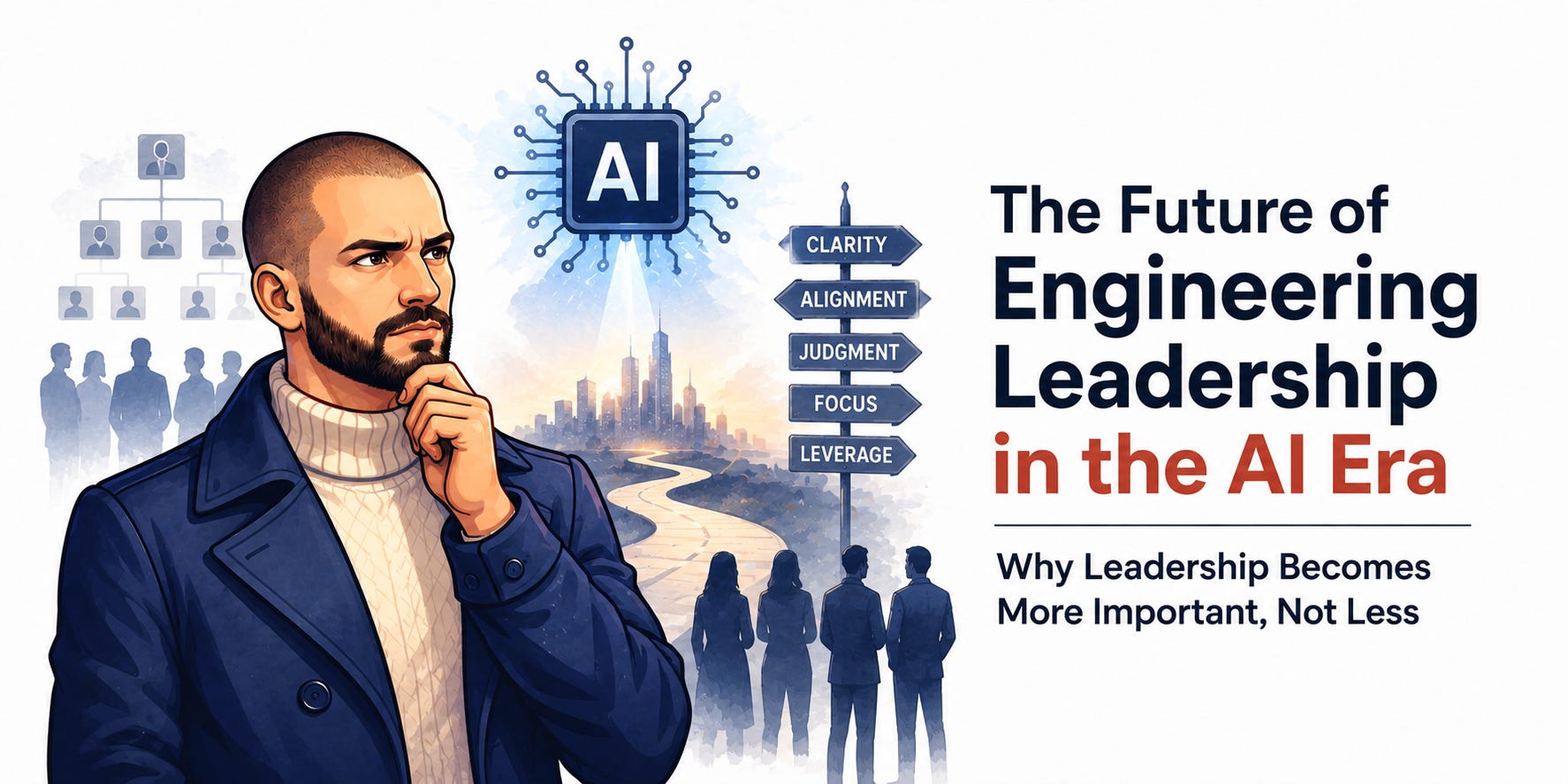
For years, engineering leadership in tech followed a relatively predictable formula.
Grow the team.
Add more processes.
Increase coordination.
Hire more managers as the organization scales.
And for a long time, that model worked.
Software was expensive to build.
Engineering capacity was limited.
Execution speed was the bottleneck.
Now the ground is shifting underneath that entire system.
Over the last year alone, the industry has been flooded with statements that would have sounded absurd just a few years ago.
Founders talking about teams of 5 engineers doing the work of 50.
Executives openly questioning whether companies still need large engineering organizations.
Engineers publicly wondering if management roles are becoming obsolete.
Leaders quietly asking themselves if they should go back to being ICs before it’s too late.
At the same time, AI coding tools are improving at a pace that feels difficult to mentally absorb.
What used to take days can sometimes take hours.
Prototypes appear overnight.
Entire products are being built by tiny teams with almost no operational overhead.
And naturally, panic follows speed.
The conversation across tech has become increasingly extreme:
“Management is dead.”
“Everyone needs to code again.”
“One AI engineer will replace entire departments.”
“Middle management is finished.”
Underneath all of this noise sits a much more important question.
What actually happens to engineering leadership when software itself becomes abundant?
Because this is the part many people still misunderstand:
AI is not just changing how software gets built.
It is changing where organizational bottlenecks exist.
And that changes leadership entirely.
For years, companies were constrained primarily by engineering execution.
Now many companies are slowly becoming constrained by something else:
decision quality,
organizational clarity,
prioritization,
alignment,
emotional stability under pressure,
and the ability to operate coherently while speed keeps increasing.
The irony is that AI may not reduce the importance of leadership at all.
It may simply expose which parts of leadership were never truly high leverage to begin with.
AI Already Changed the Shape of Software Organizations
One of the biggest mistakes people make right now is talking about AI as if it’s still a future disruption.
For many engineering organizations, it’s already operational reality.
The shift may not look dramatic from the outside yet.
Most companies still have org charts.
Managers still run meetings.
Teams still plan roadmaps.
But underneath the surface, the economics of software creation are quietly changing.
And once economics change, organizational structures eventually follow.
We are already seeing signals everywhere.
Shopify publicly pushed internal expectations around AI adoption and productivity.
Microsoft heavily integrated AI copilots into developer workflows and positioned AI-assisted development as a core part of engineering productivity.
Google continues investing aggressively into AI-native development tooling and automation across software workflows.
At the same time, founders and AI leaders are making increasingly aggressive predictions about software development itself.
Sam Altman has repeatedly talked about software becoming dramatically cheaper to create.
Dario Amodei discussed worlds where small groups of highly leveraged people can produce enormous output with advanced AI systems.
Whether those timelines are optimistic or not is almost secondary now.
Because the psychological effect on organizations is already happening.
Boards expect higher efficiency.
Founders expect smaller teams to move faster.
Investors increasingly question bloated organizational layers.
Engineering leaders feel pressure to justify headcount in ways they didn’t before.
And perhaps most importantly:
the bottleneck is slowly moving away from writing code itself.
That doesn’t mean software engineering suddenly becomes easy.
It means code generation is becoming less scarce than good judgment.
Today, a reasonably strong engineer with AI assistance can already:
prototype faster
debug faster
explore ideas faster
onboard into unfamiliar codebases faster
automate repetitive work faster
Which creates a strange new organizational problem.
When execution speed increases dramatically, companies can accidentally create chaos at unprecedented speed too.
More prototypes.
More experiments.
More partially finished systems.
More competing directions.
More technical inconsistency.
More local optimization.
Without strong alignment, organizations can start fragmenting faster than they scale.
And this is where many companies may realize something uncomfortable:
the future bottleneck is not simply “building faster.”
It’s deciding:
what deserves to be built
what should be ignored
what creates long-term leverage
what introduces hidden complexity
what aligns with the company’s direction
and what quietly creates organizational debt
Software is becoming increasingly abundant.
Clarity is not.
The Part Nobody Wants to Admit: Some Management Roles Were Never Truly High Leverage
AI is not only disrupting engineering.
It is exposing organizational theater.
For years, many companies unintentionally created management structures that optimized for coordination overhead instead of actual leverage.
More meetings.
More reporting layers.
More sprint ceremonies.
More status synchronization.
More dashboards explaining why work is delayed instead of reducing the causes of delay.
And when software delivery was slower and more fragmented, a lot of this looked necessary.
Now AI enters the picture and suddenly:
meetings get summarized automatically
tickets get generated automatically
documentation gets drafted automatically
updates become searchable instantly
coordination friction starts shrinking
information routing becomes cheaper
Which creates an uncomfortable question:
If most of your value disappears when AI automates administrative coordination, was that actually leadership?
This is the part the industry is still emotionally resisting.
Because many organizations quietly confused management activity with organizational impact.
There is a massive difference between:
coordinating work
andincreasing the effectiveness of an entire system
One is operational maintenance.
The other is leverage.
And AI is starting to separate those two categories very aggressively.
The lowest leverage management roles often revolve around:
forwarding information
tracking timelines
updating stakeholders
maintaining process compliance
facilitating ceremonies
escalating problems upward
translating between departments without changing outcomes
Those tasks still matter.
But they are increasingly compressible.
Especially in organizations where leaders were never deeply involved in:
technical direction
organizational design
prioritization quality
decision-making frameworks
talent calibration
conflict resolution
cultural stability under pressure
This is why some leaders currently feel existential anxiety.
Not because leadership itself is disappearing.
But because AI is forcing organizations to ask a harder question:
“What is the actual leverage of this role?”
And to be fair, some management layers may genuinely shrink over the next several years.
Particularly in environments where:
teams become smaller
seniority density increases
AI boosts individual output
communication overhead drops
cross-functional tooling improves
But there is another side to this story that many people completely miss.
As organizations become faster, more AI-native, and more compressed…
the cost of poor leadership may actually increase.
Why Engineering Leadership May Become Even More Important
One of the most dangerous assumptions in tech right now is this:
“If AI makes execution faster, leadership becomes less necessary.”
In reality, the opposite may happen.
Because speed does not remove organizational problems.
It amplifies them.
A mediocre decision inside a slow organization creates damage gradually.
A mediocre decision inside a high-speed AI-enabled organization can spread through systems almost instantly.
This is the part many people underestimate.
AI increases execution leverage.
But leverage magnifies both intelligence and dysfunction.
A highly aligned organization becomes dramatically more effective.
A chaotic organization becomes dramatically more chaotic.
And when companies move faster, leadership weaknesses stop staying hidden.
Poor prioritization becomes visible faster.
Emotional overreactions spread faster.
Technical debt accumulates faster.
Conflicting directions collide faster.
Team confusion compounds faster.
In slower environments, organizations often had time to recover from leadership inconsistency.
In high-speed environments, recovery windows shrink.
That changes the role of engineering leadership entirely.
The future challenge is not simply getting engineers to produce more output.
AI will increasingly help with that.
The challenge becomes:
preventing fragmentation
maintaining strategic coherence
protecting long-term system quality
reducing organizational noise
keeping teams aligned under uncertainty
making clear decisions while information constantly changes
This is where leadership starts becoming less about “managing work” and more about stabilizing systems under pressure.
And ironically, AI may make emotional regulation inside leadership more valuable than ever.
Because speed increases psychological pressure too.
Leaders now operate in environments where:
expectations change weekly
tooling evolves monthly
teams fear replacement
executives demand more efficiency
everyone feels urgency simultaneously
Under those conditions, reactive leadership becomes extremely expensive.
An impulsive prioritization shift can redirect entire teams unnecessarily.
A pressure-driven roadmap decision can create months of technical instability.
A leader operating from fear can unintentionally spread anxiety through an entire organization.
And this is why many AI discussions still feel incomplete.
Most conversations focus on:
productivity
automation
coding speed
headcount reduction
But fewer people talk about what happens psychologically to organizations operating at this pace.
Because the companies that survive long term may not be the ones that simply build fastest.
They may be the ones that remain coherent while moving fast.
That is a leadership problem far more than a coding problem.
The Return of the Technical Leader… But Not in the Way People Think
One of the strongest reactions to the AI shift has been the growing belief that leaders need to “go back to coding.”
And to some extent, that reaction makes sense.
Engineering leaders who completely detached from technology for years are entering a much more dangerous environment now.
Because AI changes the speed of technical evolution itself.
Leaders who:
do not understand modern AI workflows
cannot evaluate AI-generated output
cannot reason about architecture tradeoffs
cannot distinguish demos from sustainable systems
rely entirely on others for technical judgment
…become increasingly vulnerable.
Technical credibility matters more again.
But this is where the conversation often becomes too simplistic.
The future is probably not:
“Directors spending 8 hours per day shipping tickets.”
Nor is it:
“Managers disappearing entirely while everyone becomes an IC.”
Instead, the role itself is evolving into something more hybrid.
The future engineering leader likely becomes:
more technically aware
more AI-native
more systems-oriented
more strategically involved in architecture and leverage decisions
more capable of contributing directly when necessary
But not necessarily through constant hands-on execution.
Because while AI increases individual technical leverage, it also increases organizational complexity.
Smaller teams with stronger tooling can suddenly:
launch more initiatives simultaneously
experiment faster
rewrite systems faster
create infrastructure faster
accumulate hidden complexity faster
Which means the hardest problems increasingly move upward into:
tradeoff decisions
system coherence
technical direction
long-term maintainability
organizational focus
This is why the future leadership profile may look very different from both:
the traditional people manager
andthe pure senior IC
The highest leverage leaders will likely operate somewhere in between.
Deep enough technically to:
understand what is happening
challenge assumptions
evaluate quality
identify risk
guide architecture direction
But elevated enough organizationally to:
optimize the entire system
reduce friction
align functions
stabilize priorities
protect long-term clarity
In other words:
the future may not belong to “managers” or “ICs.”
It may belong to high-leverage operators who can understand both technology and human systems simultaneously.
And that combination is far rarer than most companies realize.
The Psychological Side Nobody Talks About
Beneath all the AI optimism, productivity charts, and viral demos, there is another reality quietly spreading across tech leadership:
a growing identity crisis.
Many engineering leaders will never say it publicly.
But privately, the questions are already there.
“Am I still valuable?”
“Should I go back to being an IC?”
“What happens if organizations need fewer managers?”
“Am I falling behind technically?”
“What if smaller AI-enabled teams eliminate roles like mine entirely?”
And these fears are not irrational.
The industry is genuinely changing.
But what makes this moment psychologically difficult is that it challenges something deeper than job security.
It challenges identity.
For years, many leaders built their professional confidence around:
team size
organizational scope
headcount growth
operational complexity
managerial responsibility
Now the industry is increasingly signaling that:
smaller teams may outperform larger ones
leaner organizations may move faster
AI can compress execution layers
technical leverage may matter more than organizational scale
That creates enormous internal tension.
Especially for leaders who slowly drifted away from technical depth over time.
But there is another layer to this conversation that rarely gets discussed.
Some leaders may not want to return to IC work purely because the market demands it.
Some may want to return because coding feels emotionally safer than leadership.
Coding often provides:
clearer feedback loops
more visible progress
less interpersonal ambiguity
fewer political dynamics
a stronger sense of personal control
Leadership, especially in uncertain environments, is psychologically heavier.
You make decisions with incomplete information.
You absorb organizational anxiety.
You manage conflicts without clean solutions.
You carry responsibility for systems you cannot fully control.
And AI amplifies that uncertainty even further.
Because nobody fully knows:
what organizations will look like in 5 years
how quickly roles will evolve
what skills will become dominant
how much automation actually changes team structures
Which means many leaders are now operating under a constant background pressure:
the pressure of becoming obsolete.
And ironically, this is where emotional maturity inside leadership becomes critically important.
Because fear-driven leaders tend to react in predictable ways:
micromanaging teams
chasing every AI trend impulsively
forcing premature transformations
overcompensating technically
creating organizational instability from their own anxiety
The future may not belong to leaders who panic fastest.
It may belong to leaders who can remain clear while everyone else is psychologically speeding up.
What Future-Proof Engineering Leaders Will Actually Look Like
The AI era will probably not reward leaders who simply manage process.
And it likely won’t reward leaders who retreat entirely into technical individual contribution either.
The highest leverage leaders of the next decade may look more like organizational multipliers than traditional managers.
People who increase the effectiveness of entire systems.
Because when software creation becomes dramatically cheaper and faster, the real differentiator becomes:
clarity
judgment
adaptability
prioritization
emotional stability under pressure
and the ability to keep organizations coherent while complexity explodes
The future-proof engineering leader will likely combine several capabilities that historically existed separately.
Technical credibility
Not necessarily because they write the most code.
But because they understand:
modern development workflows
AI-assisted engineering
architecture tradeoffs
technical risk
scalability implications
long-term system quality
They can challenge assumptions intelligently.
They can evaluate whether something is genuinely robust or simply an impressive demo.
And most importantly:
they stay intellectually close enough to technology to understand where the industry is actually moving.
Systems thinking
Future organizations may become smaller but more interconnected.
That means local decisions can create massive downstream effects very quickly.
Strong leaders will think beyond:
individual tickets
isolated teams
short-term velocity metrics
They will think in systems.
How does this decision affect:
technical debt?
organizational focus?
operational load?
team cognition?
long-term adaptability?
cross-functional friction?
The leaders who survive will likely optimize for overall system health, not just short-term output.
Organizational clarity
As execution accelerates, noise accelerates too.
AI can help teams build faster.
It cannot automatically ensure everyone moves in the same direction.
This is where clarity becomes a competitive advantage.
Future engineering leaders will increasingly act as clarity engines inside organizations.
Reducing:
confusion
unnecessary complexity
competing priorities
reactive decision-making
organizational fragmentation
Because in fast-moving systems, confusion compounds aggressively.
Emotional regulation under pressure
This may become one of the most underrated leadership skills of the AI era.
As uncertainty increases, leaders set the emotional tone for entire organizations.
A reactive leader spreads instability quickly.
A grounded leader stabilizes decision-making across teams.
And this matters more than many technical leaders realize.
People do not only absorb strategy from leadership.
They absorb emotional state too.
Especially during uncertainty.
Future-proof leaders will not necessarily be the loudest, fastest, or most aggressively optimistic people in the room.
They may simply be the people who:
remain clear under pressure
avoid impulsive decisions
regulate urgency before it spreads
create psychological stability during rapid change
That becomes enormous leverage in environments where everyone else is emotionally accelerating.
Adaptability without panic
The strongest leaders will not blindly resist AI.
But they also will not worship every new tool or trend emotionally.
They will stay adaptive without becoming reactive.
That balance matters.
Because organizations can destroy enormous amounts of value by:
chasing hype cycles
rebuilding systems impulsively
constantly reorganizing
forcing premature transformations
optimizing for speed without understanding consequences
Future-proof leadership requires enough flexibility to evolve…
without losing strategic coherence in the process.
The future engineering leader may ultimately become something closer to:
part technologist,
part systems designer,
part organizational architect,
part pressure stabilizer.
Not someone who simply manages execution.
But someone who helps entire organizations think clearly while moving fast.
Final Reflection
AI will likely automate large parts of software creation.
But it won’t automatically solve:
poor decisions
organizational chaos
reactive leadership
misalignment under pressure
or the human side of complexity
In many ways, AI may actually amplify those problems.
Because when speed increases, unclear thinking becomes far more expensive.
That’s why I don’t believe the future belongs purely to managers or purely to ICs.
It belongs to leaders who can:
think clearly under pressure
combine technical understanding with systems thinking
create alignment in fast-moving environments
and stabilize organizations while uncertainty keeps growing
Software is becoming abundant.
Clarity is not.
And that may become one of the most valuable leadership skills of the next decade.
If you’re a tech leader, founder, or engineering executive navigating this shift and want to improve decision quality, emotional regulation, and organizational clarity under pressure, that’s exactly the kind of work I focus on through my advisory practice.