Leadership in the Age of AI: What Will Still Matter When Machines Write the Code
For a long time, the path to engineering leadership looked fairly predictable.
You became the person who understood the system best.
The one who could solve the hardest technical problems.
The one others came to when the architecture became complicated or production started burning.
In many teams, leadership was simply the natural next step for the strongest engineer in the room.
And for years, that model worked.
But something is quietly changing the foundations of how software is built.
AI tools are writing code.
AI agents are debugging problems.
AI systems can analyze logs, propose architectures, and even generate entire features.
This raises an uncomfortable but important question.
If machines increasingly handle the mechanics of coding, what exactly will engineering leaders be valued for?
The answer is not that leadership becomes less important.
In many ways, it becomes more important than ever.
But the source of that value is shifting.
The leaders who will thrive in the coming years will not necessarily be the ones who can write the most complex systems themselves.
They will be the ones who can understand problems clearly, make good decisions under uncertainty, and guide both people and intelligent tools toward the right outcomes.
In other words, the role of an engineering leader is quietly evolving.
And the skills that mattered most ten years ago may not be the skills that matter most in the decade ahead.
The Shift That Is Already Happening
The change is not theoretical anymore.
You can already see it inside engineering teams.
- Developers are using AI tools to generate functions in seconds.
- Tests that used to take hours to write can now be drafted almost instantly.
- Debugging sessions that once required deep digging through logs are increasingly assisted by systems that can analyze the problem and suggest possible fixes.
What used to be purely manual engineering work is gradually becoming augmented work.
A developer describes the intent.
The system proposes an implementation.
The developer reviews, adjusts, and moves forward.
The speed difference is significant.
Tasks that once required a full day of focused coding can sometimes be completed in a fraction of that time.
This doesn't mean engineers are becoming obsolete.
But it does change the nature of the work.
Less time is spent on writing every line of code from scratch.
More time is spent on evaluating solutions, validating outputs, and deciding which direction is worth pursuing.
In other words, the center of gravity in engineering work is slowly shifting.
From producing code to guiding systems that produce code.
And this shift doesn't only affect individual engineers.
It reshapes what leadership inside engineering organizations actually means.
Because when productivity tools become dramatically more powerful, the real constraint in a system is no longer how fast people can type code.
The constraint becomes something else.
- Clarity of problems.
- Quality of decisions.
- Alignment of people.
- And the ability to focus the team on the work that actually matters.
Those are not problems that AI tools can solve on their own.
They are leadership problems.
And as AI becomes more capable, those leadership responsibilities become even more important.
The New Role of an Engineering Leader
For many years, engineering leadership often followed a familiar pattern.
The best engineer became the lead.
The person who understood the system the deepest became the architect.
And the person who could solve the hardest technical problems gradually moved into management.
Technical authority was the foundation of leadership.
If something critical broke in production, the leader was expected to step in.
If the architecture was unclear, the leader defined it.
If the team got stuck, the leader often solved the problem personally.
But as engineering work becomes increasingly augmented by AI, the center of leadership begins to move.
The leader is no longer the person who needs to produce the most technical output.
Instead, the leader becomes the person who provides clarity and direction in a system that is becoming more complex and faster moving.
Think about a typical future engineering team.
Developers are working with AI copilots.
Parts of the codebase are generated with the help of intelligent tools.
Automated systems analyze logs, run tests, and propose fixes.
Some tasks that once required entire teams can now be handled by a much smaller group.
The question is no longer who can write the most code.
The real question becomes something else.
Who understands the problem deeply enough to guide the work?
Because when tools can generate many possible solutions quickly, the most valuable skill becomes the ability to decide which problems are worth solving and which direction the team should pursue.
This is where leadership becomes critical.
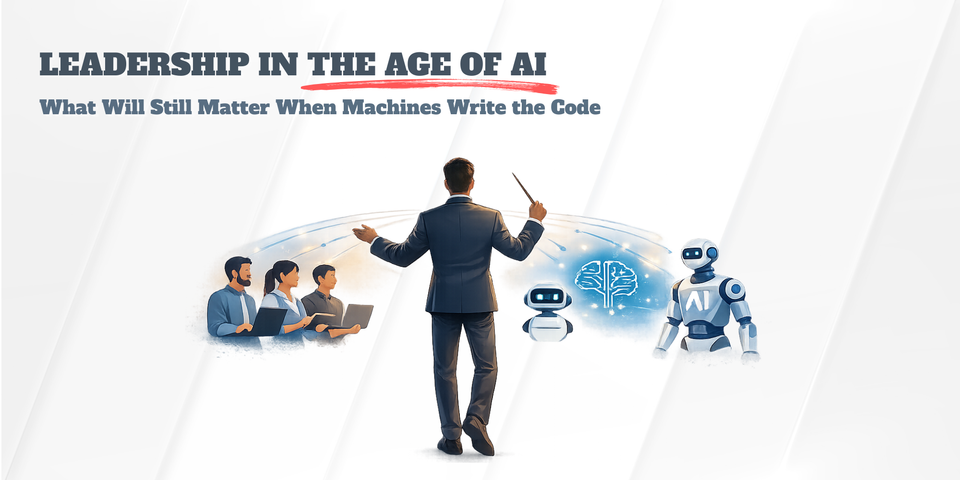
Engineering leaders increasingly act as orchestrators of a system that includes:
People.
AI tools.
Processes.
Business priorities.
Their role is to create the conditions where all of those parts work together effectively.
- That means defining problems clearly.
- Setting priorities that matter to the business.
- Helping the team make good decisions when there are multiple possible paths.
In this environment, leadership is less about being the strongest individual contributor and more about being the person who keeps the entire system aligned.
The best leaders will not necessarily be the ones who can out-code everyone else.
They will be the ones who can think clearly, make good decisions, and guide both people and intelligent tools toward meaningful outcomes.
And that shift brings us to an important question.
If the role of leadership is changing, what skills will actually matter the most in the years ahead?
The Skills That Will Become More Valuable Than Ever
As AI becomes more capable, the skills that make someone a strong engineering leader begin to shift.
Technical understanding still matters.
But the differentiating skills are increasingly moving away from writing code and toward thinking, deciding, and guiding systems.
Here are a few capabilities that will likely become even more important in the years ahead.