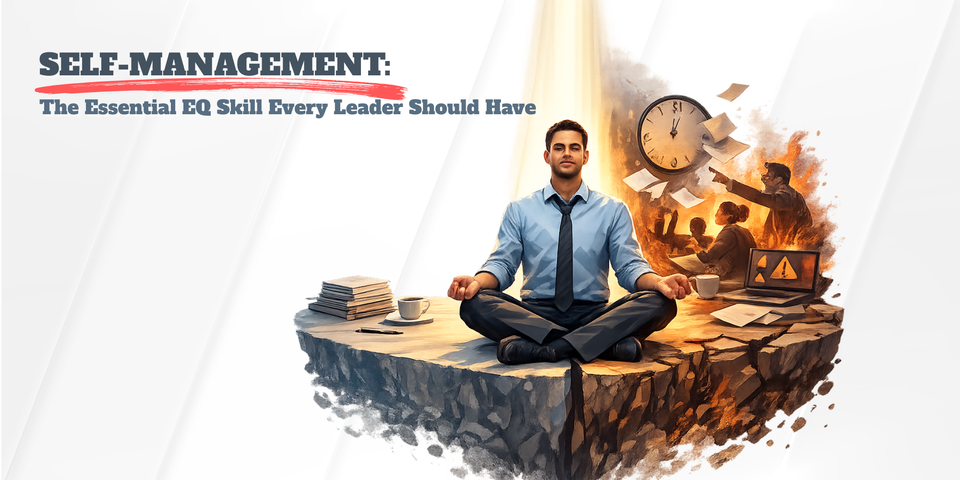
Self-Management: The Essential EQ Skill Every Leader Should Have
The Loud Leader Myth
We’ve all seen it.
The energetic leader.
The one who raises their voice when things get tough.
The one who “hits the table” and suddenly the room goes silent.
In many companies, that person gets rewarded.
They’re described as decisive.
Strong.
Charismatic.
Action-oriented.
People say:
- “That’s a real leader.”
- “He knows how to take control.”
- “She doesn’t let things slip.”
And from the outside, it looks impressive.
They speak with certainty.
They rarely hesitate.
They always seem to have an answer.
They feel like people who belong exactly where they are.
But here’s the question nobody asks:
What happens when someone disagrees with them?
What happens when a senior engineer challenges their idea in front of the team?
What happens when a project slips, or when implementation fails?
What happens when their ego gets bruised?
Because that is the moment that reveals the truth.
Not when they’re in control.
But when they feel like they’re losing it.
We’ve all witnessed it.
The tone shifts.
The voice rises.
Interruptions begin.
Arguments turn personal.
Disagreement becomes disloyalty.
Suddenly the strong leader looks… reactive.
Defensive.
Threatened.
And instead of solving the problem, they start protecting their position.
What looked like strength was often unregulated insecurity.
What looked like confidence was sometimes just dominance.
And what looked like leadership…
Was simply volume.
The uncomfortable truth is this:
Many leaders are promoted for energy, confidence, and decisiveness.
But they are rarely trained in the one skill that determines whether that authority becomes stable or volatile.
Self-management.
Because leadership is not tested when things go your way.
It is tested when your emotions get activated.
The Moment of Truth: When Pressure Exposes Emotional Weakness
Leadership feels easy when everything is aligned.
The roadmap is clear.
Delivery is on track.
The team agrees with you.
Your authority is unquestioned.
Confidence is natural in those moments.
But leadership is not defined in calm conditions.
It is defined in friction.
The real test begins when something disrupts your internal stability.
A public disagreement in a meeting.
A missed deadline.
A senior engineer pushing back on your strategy.
A stakeholder questioning your decision in front of others.
These are not just operational issues.
They are emotional triggers.
And they land fast.
Before you consciously process what’s happening, your body reacts.
Your heart rate rises.
Your jaw tightens.
You feel heat in your face.
There is a sudden urge to interrupt, defend, correct.
This is the moment of truth.
Not the disagreement itself.
But your response to the discomfort of it.
Research in social neuroscience shows that threats to status and social standing activate neural pathways similar to physical danger. To your nervous system, being publicly challenged can feel like a survival threat.
So the leader reacts.
Sometimes loudly.
Raised voice.
Sharp tone.
Cutting remarks.
Sometimes subtly.
Withdrawing.
Becoming sarcastic.
Micromanaging after being challenged.
In both cases, the pattern is the same.
Impulse replaces intention.
What looked like strength becomes reactivity.
And over time, the team learns something dangerous:
It is safer to stay quiet.
It is safer not to challenge.
Innovation does not disappear because leaders lack intelligence.
It disappears because they lack self-management.
The Neuroscience of Impulse: Why Leaders Snap
Most leaders believe they “choose” their reactions.
In reality, many reactions happen before conscious choice enters the picture.
When you perceive a threat, whether physical or social, the brain activates the amygdala. This almond-shaped structure plays a central role in threat detection and emotional processing.
It is fast.
Automatic.
Protective.
The amygdala does not wait for context.
It scans for danger and reacts in milliseconds.
Psychologist Daniel Goleman popularized the term “amygdala hijack” to describe what happens when emotional responses override rational thinking. In these moments, the emotional brain temporarily outpaces the prefrontal cortex, the area responsible for judgment, impulse control, and strategic thinking.
Emotion arrives first.
Reason arrives later.
Under stress, cortisol levels rise. Research shows that elevated stress hormones reduce activity in the prefrontal cortex and narrow cognitive flexibility. In simple terms, when you feel threatened, your ability to think clearly decreases.
Now consider leadership.
Leadership constantly exposes you to:
Uncertainty.
Conflicting opinions.
Status challenges.
Time pressure.
Public evaluation.
To the brain, these are not abstract inconveniences.
They are perceived threats.
A disagreement in a meeting can activate the same neural circuitry as physical danger. Social rejection and status loss light up similar regions of the brain as physical pain.
So when a leader snaps, interrupts, or escalates…
It is rarely calculated aggression.
It is neurological autopilot.
The problem is not that emotion exists.
The problem is when emotion drives behavior unchecked.
And speed is not always strength.
The leaders who appear calm under pressure are not less emotional.
They are better regulated.
They have trained the space between trigger and response.
And that space is where leadership maturity lives.
What Self-Management Actually Is (And Isn’t)
When people hear “self-management,” they often misunderstand it.
- They imagine emotional suppression.
- Staying silent when upset.
- Forcing calm while boiling inside.
- Avoiding confrontation to “keep the peace.”
That is not self-management.
That is emotional compression.
And compressed emotion eventually leaks.
Self-management is not about becoming less emotional.
It is about becoming less automatic.
It does not mean you do not feel anger, frustration, embarrassment, or threat.
It means those emotions do not decide your behavior for you.
A self-managed leader can feel intense frustration and still respond with composure.
They can feel challenged and still remain curious.
They can feel insecure and still choose stability.
That distinction is everything.
Self-management is the ability to:
- Notice internal activation early.
- Name the emotion accurately.
- Interrupt the default reaction.
- Choose a response aligned with values, not ego.
It is not weakness.
It is control at the highest level.
In fact, suppression and impulsivity are two sides of the same coin.
Both are forms of being controlled by emotion.
One explodes outward.
The other implodes inward.
Neither is regulated.
True self-management is different.
It expands the gap between stimulus and response.
And in that gap, you regain authorship over your behavior.
This is where authority becomes stable.
Not because you dominate the room.
But because you dominate your impulses.
And that is the foundation of emotional intelligence in leadership.
The SELF Command Model
A Practical System for Emotional Self-Management
Self-management is not a personality trait.
It is a trainable system.
And like any system, it works best when it is structured.
Here is the model I teach leaders who want authority that remains stable under pressure.