Why Most Leaders Never Reach True Self-Awareness
Over the past few years of coaching leaders on self-awareness, I’ve noticed a consistent pattern.
Most leaders believe they are self-aware.
And technically, many of them are.
They reflect on their decisions.
They analyze their reactions.
They can articulate what happened in difficult conversations.
They can explain their reasoning.
From a cognitive standpoint, they score high.
But cognitive reflection is only the first level of self-awareness.
Psychological research separates awareness into 4 different components.
What I’ve found in practice is that most leaders stop at Level 2 or 3.
Not because they lack intelligence.
But because deeper awareness begins to challenge identity-level beliefs.
And that is where the real work starts.
Through coaching hundreds of hours of conversations, I structured what I now call:
The 4 Levels of Emotional Self-Awareness™
This framework integrates research from emotional intelligence theory, cognitive behavioral psychology, and emotion regulation science – but applies it specifically to leadership.
Because leadership magnifies emotional blind spots.
And if those blind spots remain unresolved, they show up as:
Defensiveness.
Ego-driven decisions.
Chronic stress.
Quiet resentment.
Burnout.
High EQ is not about behaving correctly.
It is about reducing internal friction.
And that requires moving through all four levels.
The 4 Levels of Emotional Self-Awareness™
Through years of coaching I’ve observed that emotional self-awareness develops in stages.
Not everyone progresses through all of them.
And the deeper you go, the fewer people you’ll find there.
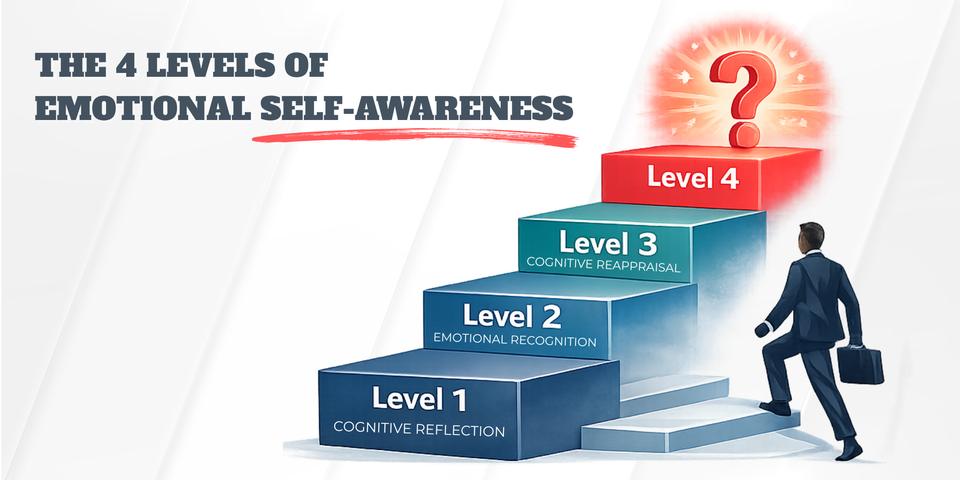
Here are the four levels:
Level 1 – Cognitive Reflection
Seeing your patterns.
Level 2 – Emotional Recognition
Admitting what you truly feel.
Level 3 – Cognitive Reappraisal
Understanding and restructuring the beliefs behind those emotions.
Level 4 – ???
I'll reveal it at the end of this article for dramatic purposes. 😅
Most leaders operate confidently at Level 1.
Some reach Level 2.
A smaller group learns Level 3.
Very few reach Level 4.
Let’s start at the beginning.
Level 1 – Cognitive Reflection
“I see what I do.”
This is where self-awareness begins.
It is the ability to step outside yourself and observe:
Why did I react that way?
Why do I interrupt certain people?
Why do I avoid specific conversations?
Why does this situation trigger me repeatedly?
Psychology refers to this capacity as metacognition – thinking about your thinking.
It involves executive function and reflective reasoning. It is associated with higher-order cognitive control in the prefrontal cortex.
In leadership, Level 1 looks like this:
You replay meetings in your head.
You analyze your tone.
You notice patterns in your decisions.
You recognize recurring conflict themes.
This level is valuable.
In fact, many leadership programs stop here and label it “self-awareness.”
But here’s the limitation:
At Level 1, you understand your behavior.
You do not yet understand the emotion driving it.
And without emotional insight, cognitive reflection becomes sophisticated rationalization.
You can explain your reaction.
You can justify your tone.
You can intellectualize your defensiveness.
But you haven’t touched the core.
Level 1 creates intelligent leaders.
It does not yet create emotionally integrated ones.
And this is where most people believe they’ve done enough work.
They haven’t.
Because awareness of behavior is only the surface.
The next level is where identity starts to shake.
Level 2 – Emotional Recognition
“I admit what I feel.”
If Level 1 is about observing behavior,
Level 2 is about confronting the emotion beneath it.
This is where self-awareness stops being intellectual and starts becoming destabilizing.
Because behavior is neutral.
Emotion is personal.
At Level 2, the question shifts from:
“Why did I react that way?”
to
“What was I actually feeling in that moment?”
Not the socially acceptable answer.
The real one.
Was it irritation?
Or was it feeling dismissed?
Was it frustration?
Or was it feeling incompetent?
Was it “high standards”?
Or was it envy?
This is where most leaders get stuck.
Not because they lack emotional vocabulary.
But because certain emotions threaten identity.
Research in emotional regulation shows that accurately labeling emotions reduces amygdala activation and increases prefrontal control. This is known as affect labeling.
But labeling anger is easy.
Labeling shame is not.
Labeling disappointment is manageable.
Labeling envy, resentment, insecurity, or fear of irrelevance is destabilizing.
Especially for high performers.
Many leaders build their self-concept around competence, strength, and certainty.
Admitting:
“I felt inferior in that meeting.”
“I felt threatened by their success.”
“I felt exposed.”
can feel like self-image destruction.
This is where ego defensiveness activates.
Psychological studies on ego threat show that when core identity is challenged, people distort, deny, or rationalize instead of integrating the emotion.
They move back to Level 1.
They explain instead of admit.
And that is why self-awareness stalls here.
In coaching, this is the most delicate stage.
Because if handled poorly, emotional recognition can weaken confidence.
But if handled correctly, it strengthens it.
When leaders safely confront buried emotions, something surprising happens.
They discover that:
- Envy reveals unmet ambition.
- Shame reveals misaligned standards.
- Resentment reveals unspoken boundaries.
- Hatred often masks fear.
These emotions are not weaknesses.
They are signals.
Level 2 is not about judging what you feel.
It is about owning it without collapsing under it.
And very few people can do that alone.
Level 3 – Cognitive Reappraisal
“I understand why I feel this.”
Once a leader can accurately admit what they feel, the next question becomes:
"Where is this emotion coming from?"
Emotions do not appear randomly.
They are responses to interpretation.
And interpretation is shaped by belief.
This is where Level 3 begins.
In psychology, this stage aligns with what is known as cognitive reappraisal – a core concept in Cognitive Behavioral Therapy and one of the most researched emotion regulation strategies in modern psychology.
The idea is simple:
We don’t react to events.
We react to what we believe those events mean.
If a team member challenges you publicly and you feel anger, the anger is not caused by the challenge.
It is caused by an interpretation:
- “They are disrespecting me.”
- “If I lose control, I lose authority.”
- “I must always appear certain.”
Underneath emotion lies belief.
At Level 3, leaders learn to identify those core beliefs and examine them.
Envy may reveal the belief:
“There is limited status. If they rise, I fall.”
Shame may reveal:
“If I make mistakes, I lose worth.”
Resentment may reveal:
“I am responsible for everyone else’s outcomes.”
Once identified, these beliefs can be tested.
Are they objectively true?
Are they adaptive?
Are they serving long-term leadership effectiveness?
This is where leaders become composed.
They learn to reinterpret.
“They are not disrespecting me. They are stressed.”
“This mistake does not define my competence.”
“Their success does not diminish mine.”
On the outside, this looks like high emotional intelligence.
Calm responses.
Measured tone.
Strategic reactions.
And many leaders stop here.
Because from a behavioral standpoint, it works.
But here is the subtle limitation:
At Level 3, the leader has cognitively reframed the emotion.
They can respond correctly.
But the original emotional impulse may still exist internally.
The nervous system may still spike.
The ego may still tighten.
They are managing emotion.
Not yet transforming it.
This is high-functioning EQ.
It is effective.
But it still requires effort.
And effort over time becomes exhaustion.
Which brings us to the final level.