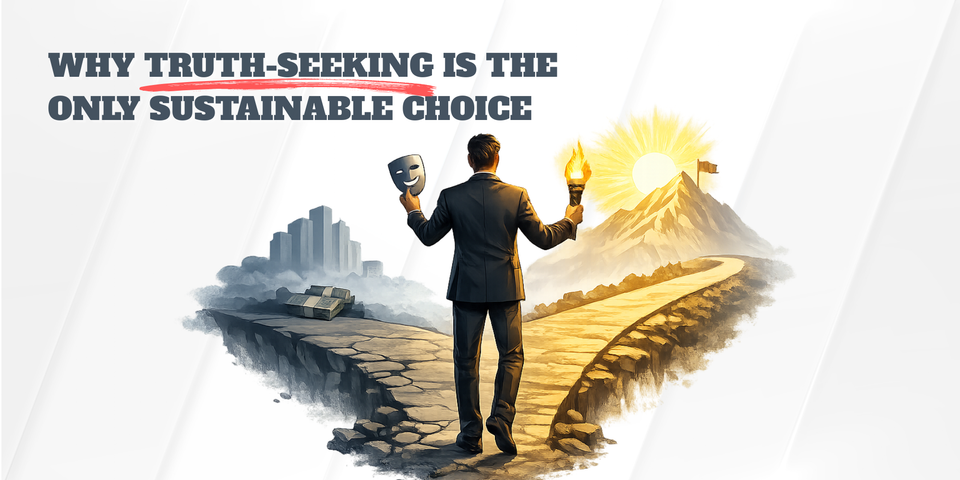
Why Truth-Seeking Is the Only Sustainable Choice
Telling the truth is rarely the easiest option.
As leaders, we often find ourselves in situations where truth feels dangerous.
Dangerous for the person in front of us.
For the team.
For the company.
For the client relationship.
So we soften it.
Decorate it.
Delay it.
Or sometimes, quietly replace it with something more convenient.
In business, this has almost become normal.
We lie to close the deal.
We exaggerate to motivate the team.
We avoid the hard truth to protect someone’s confidence.
We stay silent to avoid conflict.
And in the moment, it often works.
But there’s a reason this strategy never holds.
“In the long run, there is no such thing as a successful lie.”
– Mark Twain
This article is about why truth-seeking – outwardly and inwardly – is not just a moral choice, but the only sustainable leadership strategy.
Why leaders bend the truth (and why it feels justified)
Most leaders don’t lie because they’re unethical.
They lie because they care.
They care about:
- Protecting morale
- Keeping momentum
- Avoiding unnecessary tension
- Not crushing someone’s ambition
- Hitting targets they’re accountable for
Truth, in those moments, feels too sharp.
Too risky.
Too disruptive.
So instead of saying: “We won’t hit that deadline.”
We say: “It’s tight, but we’re optimistic.”
Instead of: “This role isn’t a fit.”
We say: “Let’s see how things evolve.”
Instead of: “This strategy isn’t working.”
We say: “We’re still learning.”
Each individual decision feels reasonable.
Even kind.
But what makes this dangerous is not the intention – it’s the pattern.
Once truth becomes flexible, people start sensing it.
They stop listening to words and start decoding tone.
They stop trusting clarity and start guessing reality.
And the moment that happens, leadership becomes much harder than telling the truth ever was.
The hidden cost: trust debt always comes due
Every time the truth is bent, something small is created.
Not a crisis.
Not immediate damage.
A debt.
At first, it’s invisible.
People nod.
Deals close.
Work continues.
But slowly, something shifts.
People stop taking words at face value.
They start reading between the lines.
They listen for what’s not being said.
Once that happens, even the truth stops working.
This is the part many leaders underestimate:
You don’t lose trust when you lie.
You lose the ability to be believed.
And that’s far more expensive.
Execution slows because everything needs verification.
Alignment weakens because people hedge instead of committing.
Teams protect themselves instead of the mission.
Stephen M.R. Covey described this clearly:
Low trust increases friction, slows speed, and raises cost.
Not metaphorically.
Operationally.
What looked like a harmless shortcut earlier turns into drag everywhere later.
And the worst part?
When leaders finally do decide to tell the truth, it often lands as manipulation.
Not because the truth is wrong – but because credibility was already spent.
Trust debt always gets paid.
Usually with interest.
And it’s almost always more painful than the original truth would have been.
The paradox: truth hurts now, but protects everything later
Telling the truth can cost you.
It can cost a relationship.
A client.
Revenue.
Approval.
Comfort.
In the short term, honesty often feels like a loss.
That’s why so many leaders avoid it.
But there’s a paradox most only understand after paying the price of dishonesty:
The pain of truth is finite.
The cost of lies compounds.
Truth has a strange quality.
It creates tension, but it also creates stability.
It can upset people, but it removes ambiguity.
It may slow things down briefly, but it prevents explosions later.
Soft lies feel kind.
Hard truth is kind – just delayed in its relief.
Leaders who choose truth early trade short-term discomfort for long-term authority.
They don’t have to defend stories.
They don’t have to remember what version they told whom.
They don’t have to manage confusion they created themselves.
Reality becomes the shared reference point.
And once that happens, something powerful occurs:
People stop guessing.
Teams stop bracing.
Decisions get cleaner.
Truth doesn’t make leadership easier in the moment.
It makes it simpler over time.
The hardest truth is the one about yourself
Most leaders think truth-seeking is about what they say to others.
In reality, it starts with what they’re willing to admit to themselves.
We all tell ourselves stories.
That we’re being reasonable.
That our intentions are pure.
That the problem is mostly “out there.”
That if others understood more, things would be easier.
These stories protect our ego.
They soften the discomfort.
They help us move through the day without questioning ourselves too much.
But they also quietly limit us.
Because when you lie to yourself – even gently – you build on unstable ground.
Truth here hurts more than any external feedback ever could.
It challenges the image you have of yourself.
It exposes blind spots.
It dismantles convenient explanations.
And that’s exactly why it’s powerful.
False confidence is loud, brittle, and defensive.
Real confidence is quiet, grounded, and resilient.
It comes from knowing where you stand – without illusion.
When leaders face their own truth:
- defensiveness drops
- learning accelerates
- decisions get cleaner
- reactions become less personal
You stop needing to be right.
You start needing to be accurate.
And that shift changes everything – how you listen, how you lead, and how much trust others place in you.
Because people can sense when someone is standing on solid ground.
What truth-seeking leadership creates
When leaders consistently choose truth, something subtle but powerful changes around them.
People speak earlier.
Not because they’re braver – but because it’s safer.
Problems surface when they’re still small.
Not when they’ve already turned into fires.
Conversations get shorter and clearer.
Less guessing.
Less politics.
Less emotional buffering.
Truth-seeking leaders don’t need to demand honesty.
They make it possible.
When people trust that reality won’t be punished, they stop hiding it.
That’s when teams shift:
- from protecting themselves to protecting the work
- from managing impressions to solving problems
- from silence to contribution
This is why high-performing teams aren’t just smart – they’re honest.
Not brutally honest.
Not careless.
But grounded in reality.
And there’s a second-order effect many leaders don’t anticipate:
Decision-making speeds up.
When everyone is working with the same facts, alignment becomes natural.
Energy stops being wasted on decoding intent or second-guessing messages.
Truth reduces noise.
Over time, leaders who consistently tell the truth become reference points.
People check with them when things are unclear.
They’re trusted with bad news.
Their words carry weight – not because they’re loud, but because they’re reliable.
That’s the quiet advantage of truth-seeking leadership.
It doesn’t just improve culture.
It improves outcomes.
Truth accelerates progress – at every level
Imagine a world where truth was the default.
Where leaders said what was real instead of what was convenient.
Where companies acknowledged reality early instead of managing optics.
Where bad news traveled fast – and solutions traveled faster.
Progress would accelerate.
In business, fewer problems would reach crisis level.
Teams would spend less energy protecting narratives and more energy improving systems.
Innovation would move faster because reality would no longer be filtered to protect egos.
At a societal level, trust would rise.
Coordination would improve.
Decisions would be made on shared facts, not distorted stories.
But this isn’t just a thought experiment.
Every organization is its own small world.
And within that world, leaders decide whether truth is safe or dangerous.
When truth is unsafe, people optimize for survival.
When truth is welcomed, people optimize for progress.
That’s why truth-seeking leadership isn’t just a personal virtue.
It’s a force multiplier.
It shapes culture.
It sets norms.
It leaves a legacy.
Not a legacy of perfection – but a legacy of integrity that others can stand on.
EQ framework for telling the truth without destroying trust
Telling the truth doesn’t mean saying everything, everywhere, all at once.
That’s not honesty.
That’s emotional recklessness.
High-EQ leaders tell the truth with intention, with care, and with clarity.
Here’s a simple framework to do exactly that.