“I’m Tired of Being the Emotional Container for Everyone”
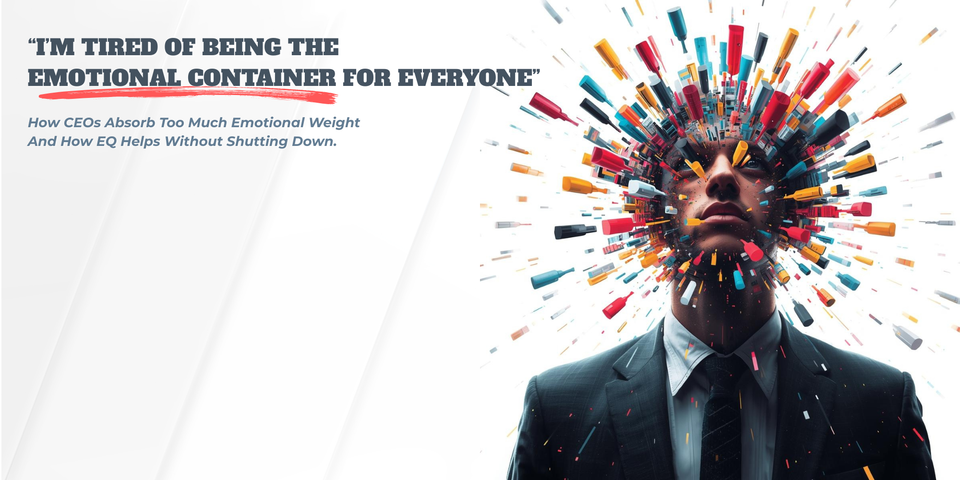
(How CEOs Absorb Too Much Emotional Weight
And How EQ Helps Without Shutting Down)
A CEO walks into a meeting calm.
Walks out carrying everyone else’s stress.
Fear from finance.
Anxiety from product.
Uncertainty from leadership.
Frustration from engineering.
And no one notices the weight added to their shoulders.
This is the part of leadership no one prepares you for.
Not the decisions.
Not the pressure.
But becoming the emotional container for the entire company.
People bring you their worries.
Their anger.
Their doubt.
Their unresolved tension.
You listen.
You absorb.
You regulate the room.
And slowly, quietly, you get tired.
Not because you work too much.
But because you carry too much.
A while ago I met a CEO who was known for being steady.
Calm under pressure.
Always available.
Always composed.
People trusted him deeply.
So they brought him everything.
Every concern came upward.
Every frustration landed in his office.
Every emotional spike found its way to him.
He listened carefully.
He validated feelings.
He reassured people.
He stabilized every conversation.
From the outside, he looked like the perfect leader.
But privately, he felt drained.
Heavy.
Disconnected.
Not from the work.
From the constant emotional intake.
He was carrying fear that was not his.
Stress that belonged to other leaders.
Anxiety that should have been resolved lower in the organization.
He thought this was part of the job.
That high EQ meant holding space endlessly.
That being a strong leader meant absorbing the weight for everyone else.
What he did not realize was this
Empathy had quietly turned into emotional overload.
And the cost showed up later.
Shorter patience.
Less curiosity.
More fatigue.
Less joy.
He was still leading well.
But he was paying for it internally.
This is how many CEOs burn out.
Not loudly.
Not dramatically.
But slowly.
By becoming the emotional container for everyone without ever emptying it.
The Unspoken Role of the CEO
No one officially assigns it.
It never appears in a job description.
But the moment you become a CEO, it arrives.
You become the emotional anchor.
People look to you for certainty.
For calm.
For reassurance.
For stability when things feel unclear.
When pressure rises, emotions move upward.
Fear flows to the top.
Frustration follows it.
Uncertainty looks for a place to land.
And it lands on you.
Teams do this unconsciously.
They are not trying to offload responsibility.
They are looking for regulation.
When someone with authority stays calm,
the nervous system of the room settles.
So leaders listen.
They absorb.
They hold space.
Over time, this creates an unspoken expectation.
- If something feels heavy, bring it to the CEO.
- If something feels unsafe, escalate it upward.
- If something feels unresolved, let the CEO carry it.
This is how CEOs slowly become emotional containers by default.
Not because they asked for it.
But because they care.
Because they are capable.
Because they feel responsible for the whole system.
And because they rarely push emotional weight back down.
The problem is not the role itself.
The problem is when the role becomes limitless.
When every emotion stays with you.
When nothing gets returned.
When empathy turns into absorption.
That is when leadership stops being grounding and starts being exhausting.
Why This Becomes Exhausting
Being the emotional container feels noble at first.
It feels like leadership.
It feels like responsibility.
It feels like care.
But over time, it starts to drain you.
Not because one conversation is too much.
But because there is no release valve.
You take in frustration.
You take in anxiety.
You take in doubt.
You take in fear.
And then you move on to the next meeting.
There is rarely a place to put those emotions down.
You cannot vent downward.
You cannot fully vent upward.
You cannot always be honest with peers.
So the emotions stay inside.
This creates constant emotional load.
Your nervous system never fully resets.
You are always slightly “on.”
Always regulating.
Always holding the room together.
Another trap appears quietly.
You start mistaking empathy for responsibility.
Instead of
“I see this emotion,”
it becomes
“I need to fix this emotion.”
Instead of listening,
you start absorbing.
Instead of acknowledging,
you start carrying.
Over time, this changes how leadership feels.
Patience shortens.
Curiosity drops.
Small issues irritate you more than they should.
You feel tired even on lighter days.
Not because the work is harder.
But because the emotional weight is constant.
This is how exhaustion sneaks in.
Not through long hours.
But through emotional saturation.
And the most dangerous part
You may still be performing well.
Still respected.
Still effective.
But internally, leadership starts to feel heavy instead of meaningful.
That is not a personal failure.
It is a signal.
A signal that empathy without boundaries eventually turns into burnout.
The Psychological Cost of Being the Container
The cost does not show up all at once.
It accumulates quietly.
At first, you just feel tired.
Then less patient.
Then less curious.
Then less present.
This is what prolonged emotional containment does to the mind.
Emotional fatigue sets in.
You are constantly regulating others,
but rarely regulating yourself.
Your emotional bandwidth shrinks.
Decision quality declines.
Not because you are less capable,
but because your nervous system is overloaded.
Too much emotional input clouds clarity.
Empathy turns into irritation.
You still care.
But you feel annoyed that people “should handle this themselves.”
That reaction is not arrogance.
It is depletion.
You start withdrawing without noticing.
Shorter conversations.
Less openness.
More distance.
It feels like efficiency.
It is actually self-protection.
Leadership stops feeling satisfying.
You are still effective.
Still respected.
Still needed.
But the joy is gone.
Psychologically, this happens because the brain was never meant to continuously hold unresolved emotional energy without release or redistribution.
Research on emotional labor shows that when people regulate others’ emotions without boundaries, stress hormones stay elevated and recovery becomes harder.
This is why burnout often surprises CEOs.
They are not exhausted by work.
They are exhausted by emotional accumulation.
And because they are still functioning, they ignore the signal.
Until one day, leadership feels heavy instead of meaningful.
And the question quietly appears:
“How did something I wanted so badly start feeling like this?”
That question is not weakness.
It is awareness.
And awareness is where the shift begins.
The EQ Misconception
Many CEOs believe this without questioning it:
“High EQ means I must hold everyone’s emotions.”
That belief is quietly destructive.
Emotional intelligence is not emotional absorption.
It is not carrying fear for others.
It is not fixing feelings.
And it is not becoming the emotional dumping ground.
High EQ is about awareness and regulation, not ownership.
You can acknowledge emotion without internalizing it.
You can listen deeply without taking responsibility for how others feel.
When empathy turns into absorption, leadership stops being sustainable.
The EQ Reframe
Emotionally intelligent CEOs make a crucial shift.
They stop asking
“How do I carry this for them?”
And start asking
“How do I stay present without taking this on?”
Your role is not to absorb.
Your role is to stabilize.
You name emotions.
You slow the room.
You clarify reality.
You return responsibility.
This is the difference between empathy and entanglement.
EQ allows you to stay connected without being consumed.
And when leaders model this, teams become more resilient instead of emotionally dependent.
Framework: The Emotional Boundary Model
This is how emotionally intelligent CEOs stop over-containing without becoming distant, cold, or unavailable.
It is not about pushing people away.
It is about keeping responsibility where it belongs.