The EQ Gap Between Founders and Their Leadership Team
A founder makes a decision in thirty seconds.
The leadership team spends thirty days trying to understand it.
Not because they lack skill.
Not because they disagree.
Not because they are slow.
They are simply working with a different level of emotional context.
The founder sees the pattern instantly.
The team sees only the words that were spoken.
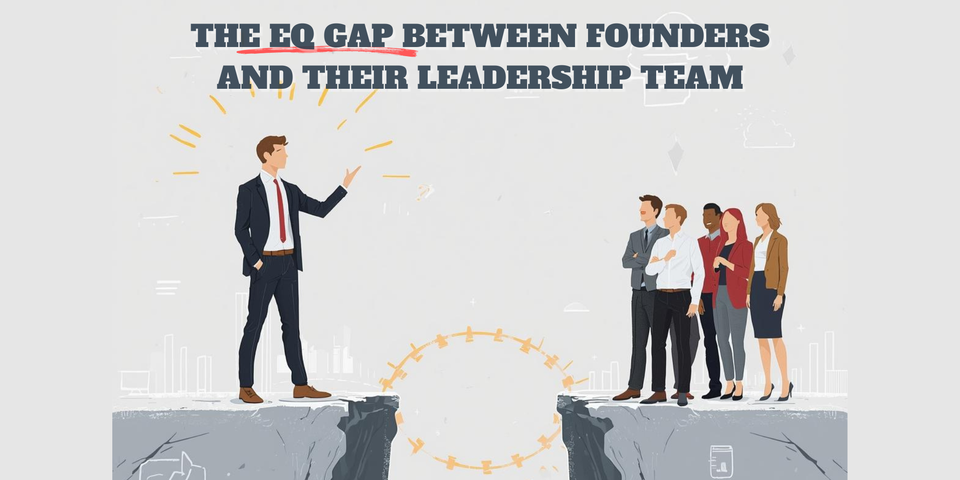
This is the EQ gap.
A space where the founder is already three steps ahead
while the team is still trying to figure out step one.
And the company pays for it in speed, alignment, and morale.
The problem is not intelligence.
The problem is unspoken emotional logic.
We all know a founder who moves faster than anyone around him.
He connects the dots before others even noticed there were dots.
He sees patterns, risks, and opportunities long before his leadership team understood the context.
It usually goes like this... he walks into a meeting and announces a major strategic shift.
To him, the decision was obvious.
The signals had been building for months.
He felt the urgency in his gut.
He had already processed the risks and the upside.
But the room freeze.
People glance at each other.
Someone asks for more data.
Someone else wants clarification on priorities.
Another leader hesitates, unsure whether this was a brainstorm, a directive, or simply a thought spoken out loud.
The founder walks out frustrated.
Why is everyone so slow?
Why do they need everything spelled out?
Why can’t they just move?
Meanwhile, the team walks out with a different emotion.
Confusion.
Uncertainty.
Pressure.
They are still trying to decode the message behind his message.
They are not resisting him.
They are trying to understand him.
What felt like clarity to the founder feels like chaos to the team.
What felt intuitive to him feels incomplete to them.
This is the EQ gap.
The silent space between how fast a founder thinks
and how clearly a team needs information to execute.
And unless the leader learns how to bridge that emotional space, the gap only grows.
The Founder’s Advantage (and Hidden Problem)
Founders move fast for a reason.
They were forged in ambiguity.
They built the company by making decisions before the data existed.
They learned to trust patterns, intuition, and timing.
They see connections others do not see yet.
This gives them a natural advantage:
• They think in leaps, not steps
• They are comfortable with chaos
• They feel urgency more intensely
• They hold the entire mental model of the business
• They switch between ideas without losing the thread
• They can move from problem to solution in a single sentence
But this strength hides a problem.
A founder’s clarity is internal.
It lives in their head, in their instincts, in their emotional patterns.
The team does not share that context.
They only hear the outer layer
the words, not the meaning
the decision, not the reasoning.
To the founder, the leap makes sense.
To the team, it looks like a jump with missing steps.
This asymmetry creates friction.
The founder thinks the team is slow.
The team thinks the founder is unclear.
Both are wrong.
Both are right.
It is not a skill gap.
It is not a motivation gap.
It is a difference in how each side processes information, urgency, and emotional cues.
And unless the founder communicates the internal logic behind the leap, the leadership team will always be three steps behind.
The EQ Gap
The EQ gap is not about intelligence.
It is not about capability.
It is not about commitment.
It is about emotional context.
Founders speak from intuition.
Teams listen for instruction.
Founders think three steps ahead.
Teams hear only the step the founder verbalizes.
Founders communicate with urgency they already processed internally.
Teams experience that urgency for the first time in real time.
Founders see the entire chessboard.
Teams see only the piece that was moved.
Here is what the EQ gap really looks like in practice
• The founder communicates intention emotionally, not explicitly
• The founder moves fast because the decision feels obvious
• The team is still working on yesterday’s direction
• The team hesitates because it feels incomplete
• The founder is solving tomorrow’s problem
• The team hears pressure, not clarity
And both sides walk away confused.
The founder thinks: Why is nobody keeping up?
The team thinks: Why do we always find out the plan after it changes?
The gap is not caused by incompetence.
It is caused by misaligned emotional pacing, different processing speeds, and missing explanations of why a decision matters.
The EQ gap appears whenever a leader’s internal world moves faster than their external communication.
The Psychology Behind the Gap
The EQ gap is not a mystery.
It comes from predictable human psychology.
Founders use intuitive decision making.
Their brains connect patterns automatically.
Years of high-pressure problem solving turn instinct into speed.
This is called automaticity in cognitive science.
They decide in seconds because their mind has already run the simulation.
Leadership teams use analytical decision making.
They need sequence, context, risk, dependencies.
They move through logic instead of instinct.
This takes longer, but it feels safer.
Urgency lands emotionally, not logically.
When a founder speaks with intensity, the team hears pressure.
Intensity activates threat response in the brain
a reaction well documented by Naomi Eisenberger and Matthew Lieberman.
The team pauses, not to resist, but to protect themselves.
Ambiguity triggers risk avoidance.
When directions feel incomplete, people slow down.
Not out of defiance, but out of caution.
Humans avoid moving when the emotional cost of being wrong feels high.
Founders switch context faster than the team can process it.
Their mind moves from one insight to another with no emotional friction.
The team, however, needs closure before moving on.
Without it, they feel unstable.
This creates a predictable dynamic
• The founder thinks in leaps
• The team needs the steps
• The founder feels clarity
• The team feels confusion
• The founder feels urgency
• The team feels pressure
• The founder sees patterns
• The team sees sudden changes
None of this is incompetence.
It is neuroscience.
It is emotional processing.
It is human behavior under power dynamics.
And until the founder understands these psychological forces, the EQ gap only grows wider.
Symptoms of the EQ Gap
You can feel the EQ gap long before you can articulate it.
It shows up in subtle behaviors that slowly become patterns.
Here are the clearest signs the gap is already active:
1. Your team asks for more clarification than you expect.
You think the direction is obvious.
They think it is incomplete.
2. Decisions slow down even when the path seems clear.
Not because people disagree.
They simply do not have the emotional context behind the decision.
3. People hesitate when you speak with urgency.
Your intensity signals pressure.
Their nervous system shifts into caution.
4. The team misinterprets your ideas as final decisions.
What was a brainstorm to you becomes a directive to them.
5. Leaders avoid making bold calls without you.
Not because they lack initiative, but because they fear being misaligned.
6. You feel like you are dragging the organization behind you.
The team is always a few beats slower.
You wonder why no one “just gets it.”
7. The team sticks to old priorities after you thought you changed direction.
Your shift felt clear to you.
To them, it felt like a passing comment.
8. People overreact to your tone, mood, or speed.
Small emotional cues from you create big emotional responses in them.
These symptoms are not signs of a weak leadership team.
They are signs of an emotional communication gap between how you think and how your team interprets you.
And until that gap is closed, alignment will always feel harder than it should be.
The Cost of the EQ Gap
When the EQ gap widens, your company does not break overnight.
It fractures slowly.
Quietly.
In ways that drain execution power without anyone noticing.
Here is what the gap actually costs:
Slower decisions
The team hesitates because they cannot read your intention.
They need more context before they can move.
Repeated misalignment
You explain the same direction multiple times, yet people still interpret it differently.
This creates confusion and frustration on both sides.
Fragmented communication
Departments start solving different versions of the same problem.
You get inconsistent updates and teams working in parallel, not together.
Leadership burnout
Your leaders spend energy decoding your words instead of executing your strategy.
They feel constant pressure to read your mind.
Founder frustration
You feel like the team is holding you back.
Like you are dragging the company instead of leading it.
Chaotic execution
Projects stall.
Priorities shift too quickly.
Everyone operates with a different understanding of “urgent.”
Loss of trust
Your team stops believing they understand what you truly want.
And you stop believing they can deliver without constant oversight.
This is the real cost.
Not money.
Not time.
But clarity, speed, and confidence.
Companies do not slow down because people lack talent.
They slow down because the emotional communication between the founder and the leadership team is misaligned.
Close the EQ gap, and the entire company accelerates.
The EQ Reframe
Most founders believe the solution is to communicate more.
More words.
More meetings.
More explanation.
But the real solution is different.
It is not about communicating more.
It is about communicating emotionally clearer.
Your team does not need more detail.
They need the why behind your decisions.
They need the emotional context that lives in your intuitive thinking.
They need to understand what you see, not just what you say.
Here is the reframe
Your talent is speed.
Your responsibility is clarity.
Speed without clarity creates chaos.
Clarity without emotional context creates confusion.
When you combine both, alignment becomes effortless.
High EQ founders do this extremely well
They explain not only the decision, but the pattern they noticed.
They share not only the direction, but the urgency behind it.
They give not only the what, but the emotional logic that makes the what inevitable.
When you articulate the internal reasoning that feels obvious to you, your team can finally keep up with your pace.
You stop feeling alone in your speed.
They stop feeling lost in your decisions.
This is the point where leadership becomes easier.
And execution becomes smoother.
Framework: The Emotional Context Protocol (ECP)
Most founders communicate decisions.
High EQ founders communicate the emotional logic behind decisions.
That is what aligns a leadership team.
That is what closes the EQ gap.
And that is what the Emotional Context Protocol is designed to do.
ECP is simple.
It has five steps.
Use it in any announcement, change of direction, or strategic pivot.