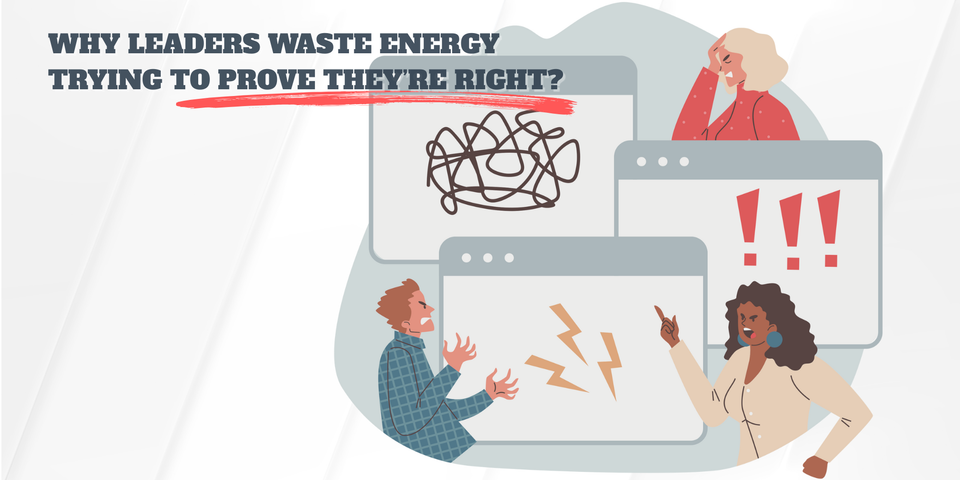
Why Leaders Waste Energy Trying to Prove They’re Right (And How EQ Fixes It)
The moment was subtle, but everyone in the room felt it.
A CEO I worked with – brilliant, experienced, respected – was in a product meeting.
Someone from the engineering team suggested a different direction for the next release.
A small change. Nothing dramatic.
But the CEO didn’t like it.
Not because it was wrong.
But because it wasn’t aligned with his idea.
What started as a discussion quickly turned into a debate.
Then into a lecture.
Then into a quiet, heavy room.
No one argued back.
No one pushed their ideas forward.
They just nodded... and checked out.
He “won” the argument.
But he lost something far more important:
- the team’s willingness to challenge him
- their creativity
- their psychological safety
- and their belief that their opinions mattered
Later, I asked him:
“Why do you get so triggered when people disagree with you?”
That question opened the real conversation...
not about product decisions,
but about the deep human urge leaders have to defend their ideas, prove their competence, and push others to align with them.
An urge that looks like leadership...
but quietly destroys it.
The Real Problem: The Ego Driven Urge To Correct Everyone
I have seen this pattern many times when working closely with founders and CEOs.
Someone in the room shares an idea.
A different angle.
A different direction.
A different interpretation.
And suddenly the atmosphere shifts. The leader feels an inner pressure to respond.
To explain.
To correct.
To bring the conversation back to their point of view.
It rarely happens because the idea is truly bad.
It happens because disagreement touches something deeper in us.
Neuroscience shows that the brain reacts to disagreement as if it were a threat. The amygdala interprets it as danger. Our body enters a defensive state even though nothing harmful is happening.
This is why leaders often feel that strong urge to convince the other person.
Not because it is necessary but because it feels protective.
The result is predictable. The more we push our opinion, the more the other person resists.
Not because our argument is weak but because people instinctively protect their autonomy.
When they sense pressure, they shut down.
And this is the tragedy of many leadership conversations. Leaders believe they are clarifying. But the team experiences it as correction. Leaders believe they are guiding. But the team feels pushed into silence.
The real problem is not the disagreement itself. It is the emotional need underneath it.
The need to feel competent.
The need to feel respected.
The need to feel right.
Once that need takes over, the discussion stops being about the idea. It becomes a quiet battle for psychological safety on both sides.
The Psychology Behind the Need To Be Right
The urge to defend our ideas does not come from logic. It comes from predictable patterns in human cognition. These patterns have been repeatedly demonstrated in scientific research.
Confirmation bias
Once we form an opinion, the brain begins searching for evidence that supports it while filtering out anything that challenges it. This effect is well documented in the work of cognitive psychologists Daniel Kahneman and Amos Tversky in their research on heuristics and biases. The more experience someone has, the more confident they feel in their existing view, which strengthens this bias.
Identity protection
People often attach their sense of competence to their ideas without realizing it. When someone disagrees, the brain reacts as if the self is being questioned. Research in social neuroscience by Naomi Eisenberger and Matthew Lieberman shows that social threats activate the same neural pathways as physical pain. This is why disagreement feels emotionally sharp even when nothing is actually at stake.
Overconfidence bias
When past decisions worked, the mind forms a belief that future decisions will follow the same pattern. Studies by psychologist Don Moore show that successful individuals consistently overestimate the accuracy of their judgments. Leaders fall into this because they have been rewarded for their instincts before.
Cognitive dissonance
Changing a belief requires accepting that an old belief might no longer be correct. Leon Festinger’s original research on cognitive dissonance explains how the mind resists information that forces us to rethink our identity, competence or previous choices. This resistance makes us argue longer than we should.
These mechanisms operate quietly beneath the surface. They create the internal pressure to correct others and defend our position. Not because the idea is perfect but because the mind is trying to maintain psychological stability.
When leaders understand these forces, the entire dynamic changes. The emotional weight behind disagreement becomes lighter. Curiosity becomes easier than defensiveness. Discussions shift from protecting identity to discovering truth.
The Hidden Cost: Innovation Dies When Leaders Need To Be Right
When leaders insist on their own viewpoint, the negative impact rarely appears immediately. It shows up quietly in how people behave. Meetings become cautious. Ideas become predictable. Team members stop offering perspectives that might challenge the leader. The company keeps moving, but with less creativity and less truth in the room.
Psychological safety is a key ingredient of high performing teams. Google’s Project Aristotle showed that teams where people feel safe to disagree consistently outperform those where they do not. The moment a leader signals that their opinion must always win, safety fades. And once it fades, innovation slows with it.
This is especially dangerous in tech. Products evolve. Architectures change. Assumptions age quickly. What worked last year may not work today. When leaders shut down alternative viewpoints, the company locks itself into old thinking.
There is also a cultural drift. When a founder or CEO always needs to be right, managers learn to behave the same way. Teams stop raising concerns or proposing unfamiliar ideas. Creativity is replaced by compliance.
The sad part is simple. You hire talented people because they see things you do not.
But if your need to be right dominates the room, their ideas stay in their heads.
Innovation does not die because people lack imagination.
It dies because people no longer feel invited to share it.
The EQ Reframe: The Real Question Is Not Who Is Right but What Is True
Leaders often approach disagreement as a competition of opinions.
Two perspectives.
One has to win.
One has to lose.
This mindset creates tension in every conversation because the focus shifts from the problem to the person. The discussion becomes a subtle test of competence instead of a search for clarity. Emotional intelligence offers a completely different lens. It replaces the urge to defend with the willingness to explore.
High EQ leaders pause before reacting. They notice the tension in their body and the impulse to correct. Instead of pushing their view harder, they get curious. They ask people to walk them through their reasoning. They try to understand what information or experience led to that viewpoint.
This moves the conversation away from identity and toward truth. What matters is not who thought of the idea. What matters is whether the idea helps the company move forward.
The shift sounds simple, yet it changes everything. People feel heard instead of dismissed. Teams participate more openly because the leader is not protecting their ego. Disagreement becomes a source of data instead of a source of conflict.
When leaders let go of the need to be right, they gain something far more valuable.
They gain access to the full intelligence of their team.
They see blind spots faster.
They catch outdated assumptions earlier.
They make decisions based on reality rather than emotion.
This is how emotionally intelligent leadership works. It does not weaken authority. It strengthens it by turning every disagreement into a clearer picture of what is actually true.
Why Openness Makes You a Better Leader
Openness is not a soft characteristic. It is one of the main predictors of strong team performance. Google’s Project Aristotle showed that teams work better when people feel safe to question ideas, challenge assumptions and speak honestly. When leaders stay curious instead of defensive, the entire team becomes more willing to share information that would otherwise remain hidden.
Research on collective intelligence from MIT also shows that groups reach better decisions when they combine multiple viewpoints. This matters even more for founders and CEOs because no one person can see the full picture in a fast changing technical landscape. Openness gives you access to the intelligence that already exists in the room, which leads to faster learning, better decisions and fewer blind spots.
The Founder and CEO Lens: You Set the Cultural Default
People in a company naturally mirror the behavior of the person at the top. If a founder or CEO reacts defensively, managers begin doing the same. If the leader shuts down disagreement, teams quickly learn that challenging ideas is risky. Culture shifts quietly, shaped by how the leader shows up in everyday conversations.
This becomes a problem when leaders insist on being right. Talented people stop sharing perspectives, not because they lack ideas, but because they assume the decision is already made. Innovation slows even when the team is capable of more. When leaders choose curiosity instead of certainty, the entire company becomes more honest, adaptive and creative.
The EQ Shift: Replacing the Need to Be Right With the Need to Learn
One of the most powerful shifts a leader can make is changing the goal of a conversation. Instead of trying to prove a point, the focus becomes understanding what is actually true.
This shift sounds small, but in practice it transforms the entire dynamic of a team.
Leaders who follow this approach stay centered, reduce friction and invite others to think at a higher level.
They replace defensiveness with curiosity.
They remove pressure from the room.
They make disagreement useful instead of stressful.
A simple framework helps make this behavior consistent.