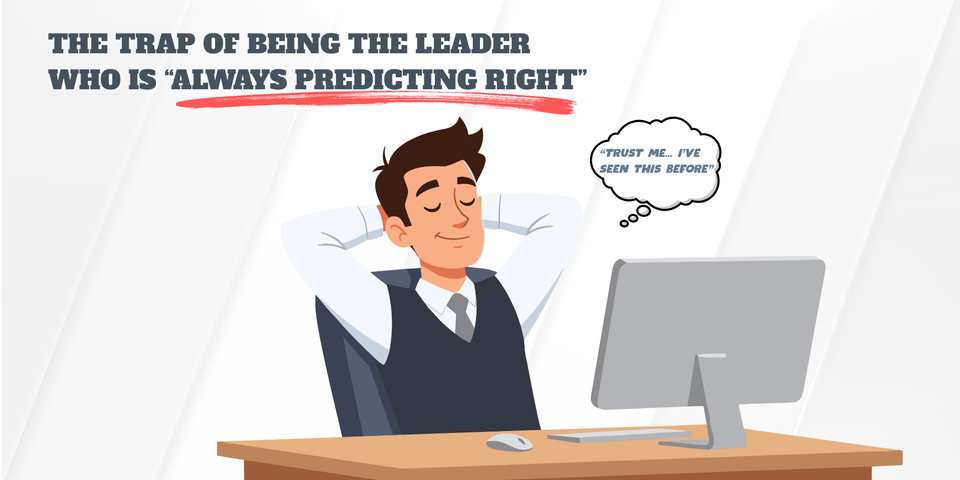
The Trap Of Being The Leader Who Is “Always Predicting Right”
For years, many leaders built their identity on one foundation.
Their ability to predict.
They were the ones who sensed risks early, read people quickly, and anticipated delays before anyone else noticed.
They were praised for foresight.
Trusted for instinct.
Respected for being “ahead of the curve.”
And over time, those moments became part of who they were.
The prophets of delivery.
The Nostradamus of software lifecycles.
The leaders who believed they could see the future because they had seen the past.
But here’s the problem.
We remember only the predictions that came true.
We forget the ones that didn’t.
And we rarely question how much of our “accuracy” was hindsight storytelling.
This is selective attention at work.
It validates our confidence while hiding our blind spots.
And it slowly turns a strength into a limitation.
Because today, prediction is no longer the superpower it once was.
The world moves too fast.
Teams are more diverse.
Technology changes direction overnight.
Rigid, assumption-driven leadership no longer keeps you ahead.
It holds you back.
This article is about making the shift.
From the leader who believes they already know how the story ends,
to the leader curious enough to hear what others see... and rewrite the story together.
The CEO Who Chose “Technical Prediction” Over Leadership Reality
Not long ago, I worked with a tech CEO who was absolutely convinced he knew exactly what kind of CTO his company needed.
He believed the only safe option was someone deeply technical.
Someone who could review every PR, argue architecture for hours, and keep the entire engineering organisation “in line.”
To him, leadership skills were a luxury.
Technical depth was survival.
Everything else felt like a risk he couldn’t afford.
So when it came time to hire a CTO, he ignored candidates with proven leadership experience.
Instead, he promoted his most brilliant solution architect.
A person who had never led a team, didn’t enjoy managing people, and openly admitted that “humans are the worst part of engineering.”
But in the CEO’s mind, this was the safe bet.
He assumed a strong architect would automatically become a strong CTO,
and he assumed that a leader with real leadership skills would be too “soft” and too far from the codebase.
He was certain.
He had seen this story play out before.
At least that’s what he told himself.
But then reality happened.
Within a year, the competition hired one of those leadership-driven CTO candidates he rejected.
Under that CTO, their organisation matured rapidly.
Delivery improved.
Retention improved.
And revenue grew far faster than his own company’s growth curve.
Meanwhile, inside his organisation, things were falling apart.
The architect-turned-CTO struggled with people management.
He avoided hard conversations.
He micromanaged technical decisions but neglected organisational health.
Senior engineers left.
Then mid-level engineers.
Then two product leaders.
Turnover quietly eroded momentum quarter after quarter.
The CEO wasn’t watching technical failure.
He was watching organisational decay, caused by the exact blind spot he was so certain he didn’t have.
And the painful part was this:
He didn’t lose because he lacked experience.
He lost because he relied on an old assumption about what makes a great CTO...
an assumption that stopped being true years ago.
He realised too late that the future wasn’t lost in bad tech decisions.
It was lost in hiring someone who could architect systems,
but couldn’t lead humans.
Why This Predictive Identity Forms
Leaders rarely wake up one morning and decide,
“I know everything. My instincts are always right.”
It happens slowly.
Quietly.
Through years of reinforcement.
For many technical founders and CEOs, the early stages of their career were built on pattern recognition.
Spotting risk before others noticed it.
Predicting failures in architecture.
Sensing who was reliable and who wasn’t.
Making fast technical calls that saved time and money.
And they were praised for it.
Over and over.
Investors said things like:
“You have great instincts.”
“You see issues before anyone else.”
“You just get people.”
Teams echoed the same message.
And every compliment became another brick in the identity:
I know how things will go.
I can trust my read more than others.
My intuition is my competitive advantage.
Over time, that belief feels like truth.
It feels earned.
It feels rational.
Psychology explains this perfectly:
selective attention.
We remember the predictions that were right.
We forget the dozens that weren’t.
We retell stories in a way that makes us the wise one in the room.
We rewrite history without even noticing.
And because those memories feel validating and “correct,” we double down on them.
The brain protects our self-image as the one who sees ahead,
especially when that image helped us succeed in the past.
But that’s exactly where the trap begins.
The identity becomes rigid.
The founder stops updating their assumptions.
They start believing that past patterns always repeat.
They assume a CTO without deep technical obsession will weaken the product.
They assume a brilliant architect will naturally lead people well.
They assume culture problems are just personality issues, not leadership gaps.
These aren’t decisions.
They are reflexes, old mental shortcuts that once worked.
And like all mental shortcuts, they become dangerous the moment the environment changes.
What made you successful early in your career is not the same thing that will keep you successful once you’re leading an organisation.
But unless leaders examine how this identity formed,
they cling to it as if their entire competence depends on it.
They don’t see it as a belief.
They see it as reality.
And that’s when prediction becomes assumption.
Assumption becomes bias.
And bias quietly shapes decisions that steer the organisation in the wrong direction.
Why This Now Holds Leaders Back
The problem isn’t that predictive instincts are useless.
It’s that the environment has changed faster than those instincts.
A decade ago, a founder could rely on technical intuition and past experience to make most decisions.
Teams were smaller.
Tech stacks were simpler.
Patterns repeated more reliably.
But today’s world punishes certainty.
AI reshapes workflows every quarter.
Organisations scale faster and become more cross functional.
People dynamics grow more complex.
And the skills required for leadership roles are radically different from what they used to be.
In this environment, rigid assumptions close more doors than they open.
A CEO who believes they can “read people” ends up misjudging high-potential leaders.
A founder who assumes technical depth is the only path to good leadership ends up promoting the wrong people.
Someone who clings to past patterns misses ideas that don’t fit their predictions.
What once kept them ahead now slows them down.
Because modern leadership isn’t about being right early.
It’s about updating your thinking quickly.
The leaders who grow are not the ones who trust their assumptions the most.
They’re the ones willing to let those assumptions be challenged, especially by people closer to the truth than they are.
From Prediction to Curiosity: The Shift Modern Leaders Must Make
The leaders who thrive today aren’t the ones who rely on old patterns.
They’re the ones who question them.
They replace certainty with curiosity.
They pause before assuming.
They listen for signals that contradict their intuition.
And they treat every strong opinion as a hypothesis, not a fact.
This shift doesn’t weaken leadership.
It strengthens it.
Because when a CEO releases the need to be “the one who sees everything,”
they create space for others to contribute what they see.
Suddenly, the junior engineer closest to the code can raise risks without being dismissed.
The product manager with market insight is heard instead of overridden.
The leadership candidate with people skills is recognized as an asset, not a liability.
Curiosity turns leadership from prediction into collaboration.
And collaboration builds healthier teams, stronger trust, and far better decisions.
This is the evolution modern organisations demand:
From
“I already know how this will go”
to
“Show me something I might be missing.”
From
“It worked before, so it will work again”
to
“The context is different, let’s re-evaluate.”
From
“My instincts keep this company safe”
to
“My openness helps this company grow.”
This is where real leadership begins.
Not in protecting your old identity, but in expanding it.
A Practical Framework: Moving From Assumption to Insight
Leaders don’t break prediction habits by force.
They break them by becoming conscious of them.
Here is a simple framework you can use to step out of assumption mode and into insight mode.
It works for hiring, decisions, strategy, and even how you interpret people.