Why Working Less Can Make You More Valuable as a Leader
A while ago, I started coaching an engineering lead who was stuck, and he did not even realize it.
On paper, he looked like a star.
The go-to problem solver.
The one who always had the answers.
The person everyone called when things broke.
He wore his “fixer mode” like a badge of honor.
Working late.
Jumping into every incident.
Reviewing every pull request.
Mentoring juniors.
Repairing CI and CD pipelines.
Coding until his brain checked out.
He believed hard work was leadership.
He believed doing more meant being more valuable.
And for a while, it felt true.
People praised his dedication.
Slack messages poured in all day:
“Can you check this?”
“You are the only one who knows this part.”
That kind of validation feels good.
It feeds the ego.
It feels like importance.
But reality did not care how hard he worked.
Despite all the effort, his manager saw a different picture:
No juniors growing into mediors
No team initiatives
No ownership beyond him
No guardrails in place
Complete micromanagement
He was not scaling the team.
He was holding it together through effort instead of leadership.
The hero mindset was collapsing.
“I do not understand,” he told me on our first call.
“I am doing everything I can.
Why does it feel like I am running and still going nowhere?”
Because he was not leading.
He was rescuing.
And there is a painful truth many strong engineers must face:
When you are the hero, the team depends on you.
When you are the leader, the team grows without you.
That was the moment everything shifted.
We stopped celebrating effort.
We started building leadership.
We started building systems, not martyrdom.
We started building guardrails, not fixes.
And that is where real transformation began.
Why Fixing Feels Safe, And Leadership Feels Scary
Fixing problems gives you certainty. It creates instant feedback. You see a problem, you solve it, and you move on. It feels productive and rewarding, and in technical roles, it becomes a big part of your identity. You are the person who knows. You are the one who jumps in. You are the hero.
Leadership operates in a different world. There is ambiguity. There is patience. There is discomfort in watching someone else try something you could do faster yourself. And for high performers, especially those who rose through technical excellence, that discomfort feels threatening. If you are not fixing, what value are you bringing? If someone else figures it out, what does that mean about your place in the team?
That is exactly why so many strong engineers get stuck. They do not fail because they lack technical ability. They fail because they cannot let go. They fear mistakes will reflect poorly on them. They believe that if they do not touch something, it will not be done right. They equate being essential with being effective.
But here is the truth that every growing leader must face:
The higher you climb, the less your success is measured by what you personally do, and the more it is defined by what you enable others to do.
This was the crossroads my client stood at. And it began with one question I asked him: Do you want to be the top engineer on the team, or do you want to lead the team? Because you cannot hold both roles forever.
That question was uncomfortable. And it opened the door to a transformation.
The Turning Point
We started shifting his mindset. Instead of asking, “How do I solve this?” he began asking, “How do I help someone else solve this?” We talked about what leadership actually looks like. It is not about touching everything. It is not about being everywhere. It is about designing clarity so the team can move without you.
This is where guardrails come in.
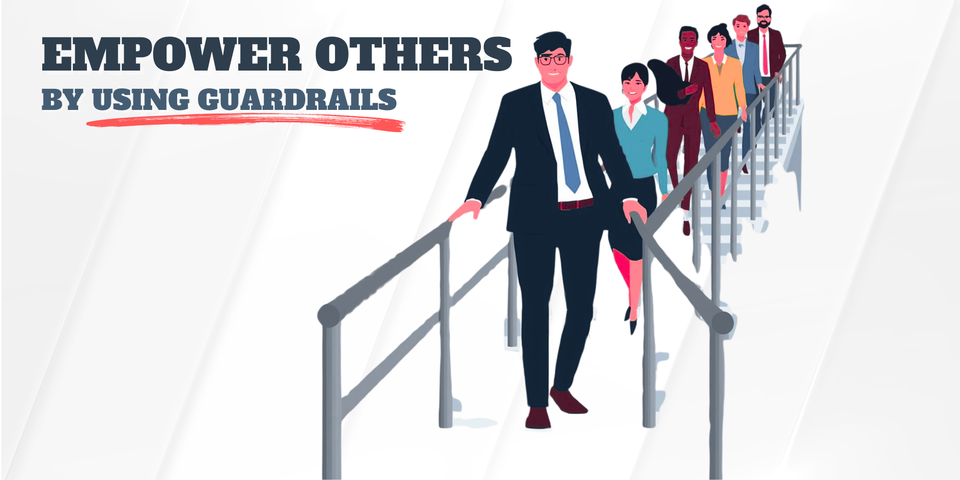
Guardrails are not control. They are not babysitting. They are not micromanagement. Guardrails are clarity, context, and trust. They answer four questions clearly:
What does success look like?
What is yours to own?
When should you involve me?
How will we check in?
Once those are in place, the leader steps back. That space is where growth happens. It is where people build confidence. It is where a team learns to think, not just execute.
At first, that space felt wrong to him. He even told me one day, “I had time today and it felt like I was doing nothing.” That is normal for technical leaders making the leap. When your worth has always come from doing, space feels like weakness, not progress. But that discomfort is a sign that leadership muscles are forming.
A calendar with breathing room is not a failure. It is the evidence of delegation, systems, and trust.
The Results
Once he embraced this shift, things changed fast. Team members stepped up. Decisions happened without him. Juniors grew. Projects moved. Conversations with other departments became collaboration instead of conflict. And, most importantly, his manager noticed a new maturity in his approach.
Recently he received public praise and a commitment that he will be promoted in the next cycle. He earned it not by doing more, but by doing less of the wrong things and more of the right things. He stopped being the person who saved the team. He became the person who built the team.
Why This Matters
Many engineers never make this transition. They stay in firefighter mode their whole career, believing effort equals value. The irony is that the harder they work, the more invisible they become. Leadership is not measured by how much you do, but by how much your team grows, performs, and owns without you.
Fixers create dependency. Leaders create capability.
If you are always busy, always stressed, and always essential, you are not scaling... you are stuck. And your team is stuck with you.
The moment you stop trying to prove yourself through effort and instead start creating impact through others, everything changes.
The Guardrails Framework: How Leaders Step Out of Fixer Mode
Once you recognize that fixing everything is not leadership, the next question becomes practical:
If I stop jumping in, how do I make sure things still move?
This is where most engineers struggle. They think the only alternatives are:
- Do it yourself so it is correct, or
- Delegate and hope for the best
Leadership lives between those two extremes.
Guardrails give your team clarity, ownership, and confidence, while giving you peace of mind and space to think. They create alignment without micromanagement and autonomy without chaos.
What Guardrails Are (And Aren’t)
Guardrails are structure. They guide action without dictating every step. They prevent disasters without preventing learning. They enable someone to move fast without running blind.
Guardrails do not mean:
• Hovering
• Correcting every detail
• Answering every question immediately
• Always stepping in when someone struggles
Guardrails do mean:
• Clear expectations
• Shared understanding of success
• Defined decision boundaries
• Predictable check-ins
• Accountability without suffocation
They are not there to restrict talent.
They are there to build it.
The Guardrails Formula
Here is a simple structure you can use for any task, project, or initiative.