How to Challenge a Decision Above You Without Getting Labeled Difficult
One of my friends came to me frustrated about his manager.
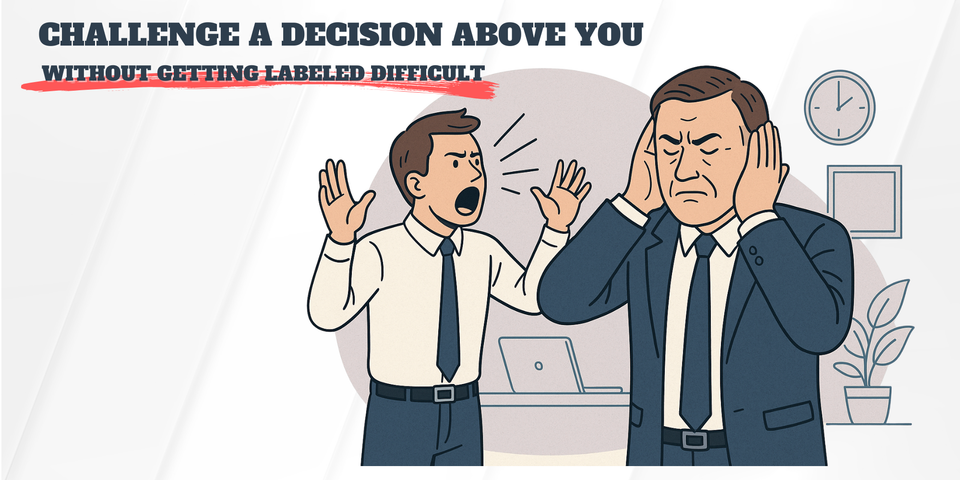
He told me his boss was harsh, dismissive, and impossible to challenge.
Every time he tried to push back on a decision, the conversation would shut down immediately.
He was convinced the problem was the other side... that his manager simply “doesn’t listen.”
But after we walked through a few real examples of how those conversations sounded, a different pattern appeared.
His manager wasn’t shutting him down because he disagreed.
He was shutting down because of how the disagreement was delivered.
He was challenging in the moment of tension.
He was doing it publicly, in front of others.
He was presenting his position as if it were the only correct one.
He was arguing to win, not to align.
To him, it felt like honesty.
To his boss, it felt like resistance.
The problem was not his viewpoint.
He was usually right on substance.
The problem was his method of confrontation; the emotional framing, the timing, and the setting; all of which made him look difficult instead of credible.
That is the trap many strong engineers fall into when they start leading:
They assume that being right is enough.
In reality, influence depends less on the strength of your argument and more on the maturity of how you deliver it.
Why Challenging Upward Feels Personal When You Believe You Are Right
Most leaders do not get into trouble because they speak up.
They get into trouble because they speak up from a place of inner certainty rather than curiosity or partnership.
When someone is convinced they are right, even if they choose polite wording, the emotional layer beneath it leaks out.
Their posture changes. Their delivery becomes firm and absolute.
They stop listening for nuance and start listening for openings to respond.
They present their opinion as the conclusion instead of as input.
Inside their own head it feels justified.
They are trying to prevent a mistake or protect the team or point out something others are missing.
It feels like responsibility.
From the perspective of the person above them, it often lands very differently.
A director or VP hears a tone that suggests the decision has not been thought through.
They sense a challenge rather than a contribution.
They hear someone defending a position instead of seeking alignment.
And once a leader forms an impression that someone is emotionally attached to being right, they start filtering all future disagreement through that lens.
They become more guarded. They listen less openly. The space for influence shrinks with each interaction.
This is the part that many strong engineers and emerging leaders underestimate.
The content of the objection is rarely the reason tension forms.
It is the conviction behind it that triggers resistance.
Technical correctness alone does not create trust.
People follow those who can disagree without making others feel attacked or judged.
That is why the skill is not in holding a strong opinion.
The real skill is in expressing it in a way that keeps your reputation intact and your door to future influence open.
Being right is not the advantage people think it is.
If the delivery closes the relationship, the correctness never gets the chance to matter.
The Goal Is Not To Win The Argument. The Goal Is To Keep Influence.
This is the mindset shift that separates emotionally mature leaders from technically correct ones.
When you challenge upward, you are not trying to defeat someone else’s logic.
You are trying to preserve your ability to be heard again in the future.
Arguments are temporary.
Reputation is cumulative.
Executives rarely punish disagreement.
They distance themselves from people who make alignment difficult.
Once that distance is created, your influence decreases quietly, without any announcement.
You are invited to fewer conversations.
Your input is asked for less often.
Decisions begin to happen without you in the room.
At that point, even if you are right, it no longer matters because you are not positioned to shape the outcome.
Influence is a strategic asset.
You spend it every time you challenge a decision.
If you choose the wrong tone, the wrong moment, or the wrong forum, the cost is higher than the benefit.
If you choose wisely, you preserve trust and you get to speak into future decisions as well.
Leaders who stay influential do not ask themselves “Am I right?”
They ask “How do I express this in a way that keeps the relationship intact?”
Winning the logic is easy.
Keeping the access to the table is the hard part.
And that is the part that decides whether your voice will continue to matter over time.
The EQ Failure Modes: What Gets People Labeled “Difficult” Without Realizing It
People rarely get labeled difficult because of what they say.
They get labeled difficult because of the way and the moment in which they say it.
Most reputational damage in leadership happens quietly and unintentionally.
Here are the most common patterns I see:
1) Challenging in the heat of the moment
When emotions are already elevated, even a logical objection sounds like resistance.
Timing matters more than logic.
2) Disagreeing publicly before aligning privately
When a senior leader feels challenged in front of others, they protect authority rather than engage in reasoning.
Public disagreement reduces psychological safety, so it gets punished silently even if the words are valid.
3) Presenting a counter-argument instead of naming a risk
When you argue as if your solution is the only correct one, you force a win-lose frame.
When you surface a risk, you create a collaborative frame.
The same idea can land in two very different ways based on framing alone.
4) Speaking in absolutes instead of probabilities
Executives hate certainty from people who do not own the full picture.
Saying “This will not work” closes the door.
Saying “I believe this creates a risk we might be underestimating” opens a conversation.
5) Interrupting the decision instead of interrogating the context
Many people challenge outputs without first asking what constraints shaped the decision.
When you skip curiosity, your disagreement sounds uninformed by default.
None of these behaviors look hostile from the inside.
They feel like truth-telling, responsibility, or conviction.
But on the receiving side, they register as friction, insecurity, ego, or a lack of organisational awareness.
And reputations in leadership are not formed by intent.
They are formed by the emotional impact you create on people who have more authority than you.
This is why pushing back correctly is an EQ problem, not a technical one.
A Respectful Structure for Challenging Upward
Disagreement does not damage influence when it is delivered with sequence and intention.
Here is a structure I teach my clients to use both in private conversations and in group settings.