

Engineering leaders are starting to hate AI-native engineering. Some of them just haven’t admitted what they hate about it yet.
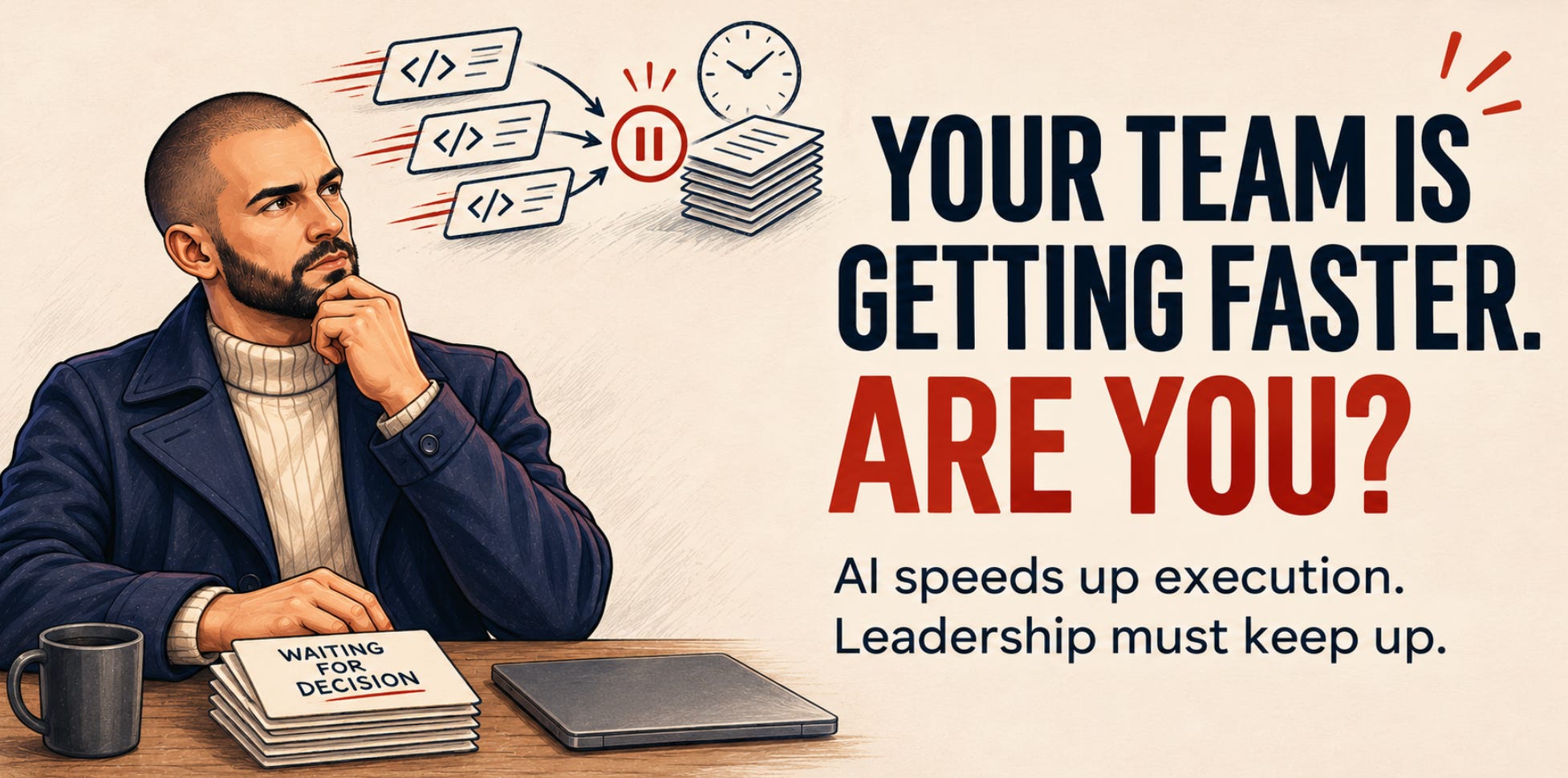
We wanted faster execution. Less time spent on repetitive work. Engineers who could explore ideas and build things without weeks of effort. But when that starts happening, it creates an uncomfortable situation for leaders whose organizations still depend on their involvement: the team gets to the next decision before the leader is available to make it.
Suddenly, people are waiting for you more often. You have more proposals to review, more trade-offs to resolve, more messages asking whether something can move forward. You spend the day making decisions and still finish with a backlog. It is easy to conclude that AI is creating too much noise, or that the team needs more discipline.
Sometimes it does. But we also need to consider something less comfortable: perhaps our way of leading depended on execution being slow enough for us to stay involved in everything.
That arrangement becomes harder to defend when the pace changes.
Faster coding does not automatically mean faster delivery
There is evidence behind the productivity promise. A 2025 paper combining three randomized field experiments at Microsoft, Accenture, and an anonymous Fortune 100 company covered 4,867 developers. Its pooled estimate was 26.08% more completed tasks with AI assistance. The authors also describe the individual experiments as noisy. That is evidence of potential gains in those settings, not a promise that every team will deliver 26% faster. [1]
DORA’s 2025 survey found that 90% of respondents used AI at work, and more than 80% believed it improved their productivity. Those are self-reported experiences. DORA also found an association between higher AI adoption and both increased delivery throughput and increased delivery instability. More output does not automatically mean a healthier delivery system. [2]
DORA describes the broader effect this way:
“AI’s primary role is as an amplifier, magnifying an organization’s existing strengths and weaknesses.”
— DORA, 2025 [3]
My argument applies that observation to leadership dependency. These findings do not establish that managers are the main bottleneck. But they give us a good reason to inspect the whole system, including decisions that wait for us.
Imagine a team reduces implementation from five days to two. The work still waits three days for a priority decision and another two for your approval. In that simplified example, ten days becomes seven. There is a gain, but five of the remaining seven days are spent waiting. Before celebrating the next coding improvement, I would want to understand why those decisions need so much time.
The bottleneck often looks like responsible leadership
This is where the conversation gets personal. Those delays rarely appear on our calendars as “blocking the team.” They appear as architecture reviews, alignment meetings, stakeholder discussions, and quick checks. Each sounds reasonable. Each may have started because we prevented a real mistake. Over time, however, a useful intervention can become a permanent dependency that nobody questions.
And being needed can feel good. People trust your judgment. You know the history. You can spot problems others miss. There is real value in that experience. There is also a temptation to preserve a setup where that value must be demonstrated through your participation in every important conversation.
Find out why decisions keep coming back to you
If I were trying to understand my own contribution to this problem, I would start with the last ten decisions that reached me. What did each actually need from me? Authority? Information? Expertise? Help resolving a disagreement? Or reassurance that I would support the person making it?
Those are different problems. A team missing business context needs access to that context. A Tech Lead who lacks experience with a particular trade-off may need coaching or a specialist. Two teams with competing priorities may need a decision from someone accountable for both. Putting all of those situations into the same escalation process guarantees that the leader keeps receiving them.
For each recurring decision, I would establish who owns it, what constraints apply, and what would make escalation necessary. “You own technical decisions” is too vague if I later challenge someone for choosing an approach I dislike. We need enough specificity that people can act without having to predict my reaction.
For example, a team might choose implementations inside its service while consulting affected teams about changes to shared interfaces. A costly vendor commitment or a change involving sensitive customer data may require a different review. The boundaries should reflect consequences, dependencies, and obligations. Seniority alone is a poor reason to route every decision upward.
Delegation fails when your preference remains the final authority
Even clear boundaries fail when leaders keep reopening reasonable decisions. If a Tech Lead makes a choice within the agreed limits and you replace it with your preference, people learn that permission is still required. You may call the next conversation a request for input. They experience it as protection against having their work overturned later.
That is why getting out of the loop requires tolerating choices you would not have made. You can question the reasoning, share information, and check the result without taking ownership back. Otherwise, you are asking people to become independent while repeatedly demonstrating that your judgment is the only one that counts.
Match the review to the risk
Jeff Bezos made a useful distinction in his 2016 shareholder letter:
“Many decisions are reversible, two-way doors. Those decisions can use a light-weight process.”
— Jeff Bezos, 2016 Letter to Shareholders [4]
This is a management principle, not an empirical finding. Its practical value is that it challenges us to justify treating every decision as equally consequential.
Of course, some decisions deserve careful review. Security, privacy, reliability, and commitments to customers do not become less important because code is cheaper to produce. Faster output can increase the amount of work that needs validation. The answer cannot be to remove scrutiny and hope that speed compensates for the damage.
The useful question is which decisions need review before action, which can be tested within agreed limits, and which can be reviewed afterward. A reversible experiment with a small audience and a working rollback is different from an irreversible migration. We should design the review around the risk, with qualified people and checks, instead of assuming that everything becomes safer when the engineering leader sees it.
This also requires deciding which mistakes we are willing to pay for. Leaders say they want ownership, but sometimes their implicit expectation is that people should make exactly the same decisions they would make, without needing their help. That expectation leaves very little room to develop judgment.
Agree on the acceptable downside before the experiment. Limit the exposure, decide what evidence would make you stop, and make recovery practical. If a team stays within those boundaries and the result disappoints, examine what it learned. Treating every unsuccessful experiment as evidence that delegation failed will quickly rebuild the approval queue.
Measure the waiting, not just the output
The next challenge is what we do with the capacity AI frees up. Faster implementation makes it tempting to start more initiatives, generate more alternatives, and increase the amount of work in progress. But if review, integration, and product decisions cannot absorb that volume, we have created more unfinished work.
Leadership has to control that pressure. Keep priorities clear enough that teams can choose what to finish. Reduce the size of changes so they can be understood and validated. Let customer feedback influence the next step before authorizing another large batch of execution. A team that produces more code while learning less about its customers has not solved the problem.
We also need to change how we measure our own responsiveness. Answering messages quickly can help, but it leaves the dependency intact. I would rather examine how long work waits for decisions, how often the same questions return, and how many choices get reopened after someone believed they had authority to make them.
Look at those signals alongside quality and customer outcomes. A shorter approval queue means little if failures and rework increase. The goal is to help the organization make sound decisions without routing all of them through you.
There is an uncomfortable test here: ask your team what they postpone when you are unavailable. Then ask what they bring to you because they expect you will want to be involved, even though they already know what they would do. You may discover that your unofficial expectations create more dependency than any written process.
Start with one decision that should no longer need you
Sometimes the constraint sits above you. Your manager expects personal approval, or executives interpret delegation as a lack of ownership. Then part of your job is to negotiate that expectation explicitly: which decisions you remain accountable for, who can make them, what evidence leadership will see, and when you will intervene. Your team cannot exercise authority that the organization punishes you for giving it.
None of this requires a massive transformation to begin. Choose one recurring decision that currently waits for you. Establish a capable owner, provide the missing context, agree on boundaries, and set a point to review outcomes. Then let that person decide. Resist the urge to reclaim the decision the first time you feel uncomfortable.
That discomfort matters. Moving away from constant involvement can feel like losing control, especially when being consulted has become evidence of your importance. Look for evidence in clearer priorities, stronger team judgment, and work progressing reliably while you are occupied elsewhere.
AI will keep changing what teams can execute and how quickly they can do it. Our responsibility is to make the surrounding organization capable of using that capacity. That includes examining habits we have defended for years as signs of responsible leadership.
Before asking your engineers how they will become faster with AI, look at what already happens when they reach you.
Which decision is waiting for you today that should no longer need you?