

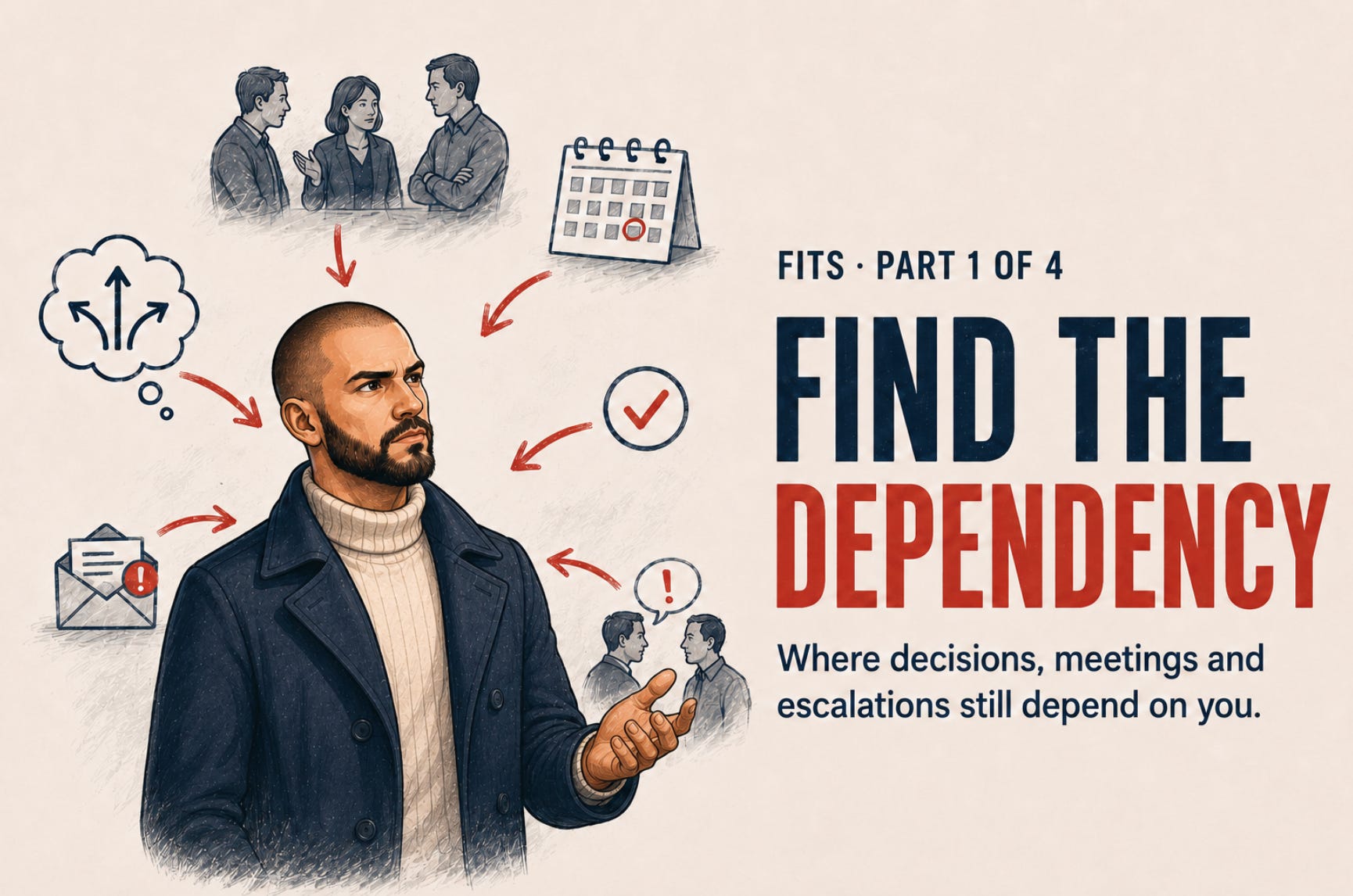
FITS Framework, Part 1 of 4: How to find the hidden decisions, meetings and escalations that still depend on you.
You delegated the project months ago.
Someone else owns the roadmap. Your Team Leads run the daily work. You are no longer assigning tasks or checking every pull request.
Still, the important decisions pause until you join…
Questions arrive with a familiar ending: “Can you take a quick look?” Documents come to you for a final review. Meetings can happen without you, but they often end with, “Let’s confirm with you first.” When a deadline starts slipping, you somehow become part of the execution again.
Nothing looks seriously broken. The work moves. Your people are capable. You may even have delegated far more than you did a year ago.
Yet you are still part of the machinery required to keep everything moving.
This kind of dependency can be difficult to see because it rarely looks like control. It usually looks like responsibility, helpfulness and high standards.
At Engineering Manager level, one team waits for your judgment. At Director level, several managers bring their hardest decisions to you. At VP or founder level, priorities, cross-functional conflicts and strategic bets keep travelling upward.
The shape changes as your scope grows. The pattern stays remarkably similar.
The FITS framework
FITS is the framework I use to help tech founders and senior engineering leaders get out of the dependency loop:
F: Find the Dependency. Map where and why work keeps returning to you.
I: Interrupt the Pattern. Change the reactions and routines that keep reinforcing it.
T: Transfer Ownership. Move decisions and responsibilities to the right level, with clear boundaries and accountability.
S: Stay Out of the Loop. Maintain visibility and standards without taking ownership back under pressure.
This first phase is deliberately diagnostic.
Before changing your calendar, cancelling meetings or delegating more work, you need to understand where the dependency actually lives. Otherwise, you can easily move the same loop into a different meeting, tool or management layer.
What counts as dependency?
Your role will always contain decisions that genuinely belong to you. Organization design, budgets, leadership appointments and certain high-stakes strategic choices should not be pushed down simply to make your calendar lighter.
Temporary dependency can also be healthy. A new manager may need more context. Someone taking responsibility for an unfamiliar domain may need short feedback loops while developing judgment.
The problem begins when decisions, responsibilities or problems repeatedly return to you even though someone else should be learning to own them.
A useful test is:
Where does the work stop when you stop?
Imagine that you become unavailable for two weeks without time to prepare everyone first.
What decisions would wait? Which meetings would lose their purpose? Who would become uncertain? Which stakeholder relationships would immediately require a replacement version of you?
Those answers reveal more than an org chart ever will.
Step 1: Map where the dependency lives
When I work through this phase with a leader, we do not start with a general question such as, “What should you delegate?” That usually produces a list of tasks the leader already knows about.
We examine what actually happened during the previous couple of weeks.
We look at the calendar, important decisions, Slack conversations, reviews, escalations and moments when the leader unexpectedly re-entered the work. We are looking for repeated movement toward the leader.
Dependency commonly hides in several places.
Decisions
Which decisions repeatedly wait for your opinion or approval?
What can your managers decide in theory but rarely decide without checking with you?
Where have you said, “You own this,” while remaining the real decision-maker?
Problems and escalations
Who brings you problems without a recommendation?
Which risks are escalated because they require your authority?
Which ones are escalated because your involvement makes everyone feel safer?
Reviews and quality control
What still needs your final check?
Where do you regularly rewrite, correct or improve work after delegating it?
Which standards live mainly in your head?
Meetings and communication
Which recurring meetings would become unclear without you?
Where are you translating between teams or stakeholders who should communicate directly?
Which conversations do you attend mainly because people make better decisions when you are present?
Confidence
Where does the team already have enough knowledge, but still seeks your reassurance?
Which managers can make the decision but want you to share the emotional risk?
When does “keeping you informed” quietly become asking for permission?
The last category is easy to miss. A person may technically own the decision while depending on you for the confidence to make it.
Once we have the examples, we sort them into three groups:
Only I should own this. The decision belongs to the leader’s role.
They could own this with better context, capability or boundaries. The dependency is temporary and can be developed.
They should already own this. The leader’s continued involvement is maintaining a loop that should have ended.
That distinction protects us from two bad conclusions: that every escalation is a failure, or that every problem should be pushed down.
The goal is to put ownership at the right level.
Step 2: See how the loop is reinforced
Finding a dependency requires more than identifying what the team does. We also reconstruct what the leader does next.
Consider a common sequence.
A Team Lead sends a message about a risky decision. The context is incomplete and the recommendation is vague. You see the consequences quickly, ask several questions and propose a direction. The Lead leaves with clarity. Work continues and a potential delay is avoided.
Your intervention worked.
It also taught everyone something.
The Team Lead learned that uncertainty can be resolved by bringing the decision to you. You learned that stepping in creates speed and relief. The next uncertain decision is even more likely to follow the same route.
This is why dependency can grow between capable, well-intentioned people. Both sides receive an immediate benefit:
The team gets speed, certainty and shared risk.
The leader gets control, usefulness and relief.
The long-term costs remain hidden because the short-term reward arrives first.
To make this visible, we take one real situation and map the full sequence:
Trigger: What happened immediately before you stepped in?
Interpretation: What did you tell yourself the situation meant?
Pressure: What risk, discomfort or emotion appeared?
Response: What did you do?
Immediate result: What became easier or faster?
Team learning: What did your response teach people to do next time?
Repetition: How did the same pattern return?
The leader may enter through different roles.
The Rescuer sees someone struggling and removes the difficulty.
The Expert sees the answer and finds it wasteful to watch others take longer.
The Quality Protector anticipates rework, client dissatisfaction or reputational damage.
The Responsible Leader believes that remaining accountable means remaining involved.
None of these roles begins with bad intent. They often helped the leader become successful. The difficulty appears when a useful strength becomes the default response to every uncertain situation.
During Find the Dependency, we observe this pattern without trying to change it yet. The next phase, Interrupt the Pattern, deals with the moment in which the leader feels pulled back in.
Step 3: Calculate what the dependency costs
Leaders usually notice the personal cost first: too many meetings, constant context switching and very little uninterrupted time.
That matters, but the organizational cost is larger.
The team borrows your judgment instead of developing its own
Every answer can solve the current problem. Repeated answers reduce the number of opportunities people have to form a recommendation, weigh trade-offs and live with a decision.
Your management layer becomes thinner than it looks
You may have Team Leads and Engineering Managers reporting to you, but their authority stays limited if the difficult decisions continue travelling upward. The structure appears distributed while judgment remains centralized.
Decisions become slower as the organization grows
Your involvement may create speed for one team. Across several teams, the same involvement creates a queue. People learn to wait for access to the person with the most context.
Strategic work keeps losing to operational certainty
Roadmap thinking, modernization, organizational design and stakeholder alignment rarely create the same urgency as a problem happening today. The dependency loop fills the calendar with work that feels immediately useful and leaves the future for whatever time remains.
The organization becomes fragile around your availability
Time off requires preparation. Slack stays within reach. A promotion creates anxiety because nobody is ready to absorb what you still carry.
We therefore measure the cost across several dimensions:
hours and recurring meetings;
delayed decisions and approvals;
rework and repeated reviews;
team confidence and judgment;
strategic work that keeps moving;
energy and attention;
what happens during the leader’s absence.
Step 4: Choose the first dependency to work on
Once leaders see the map, they often want to fix everything at once. That creates another large transformation project and makes it difficult to learn what actually changes the pattern.
Instead, we choose one or two dependencies with enough repetition to observe and enough importance to matter.
A good starting point usually has four qualities:
It happens frequently.
Someone else should reasonably be able to own it.
The current loop has a visible cost.
Changing it does not create an unacceptable business risk.
For one leader, that may be a weekly delivery meeting that still depends on their presence. For another, it may be architectural decisions that senior engineers bring up without a recommendation. At a higher level, it may be managers escalating stakeholder conflicts they have enough authority to resolve.
The output of this phase is concrete:
a map of where work and decisions return to the leader;
a clear view of how the leader’s own response reinforces the pattern;
the cost of maintaining it;
one or two priority loops;
a baseline against which progress can be measured.
Only then do we begin changing behavior.
A short dependency audit
You can start this process without designing a new delegation system.
Review your previous ten working days and write down every moment when work unexpectedly moved back toward you. Include decisions, approvals, reviews, meetings, questions and escalations.
For each one, answer:
What did the person bring to me?
What did they explicitly ask for?
What did they actually need: authority, context, skill, confidence or shared risk?
What did I do?
Where did I add value that only I could add?
What did I take over that they could have owned?
What did my response make more likely next time?
Then ask the uncomfortable question:
If this dependency disappeared, what would I lose along with it?
Perhaps you would lose a sense of control. Perhaps you would feel less technically valuable. Perhaps you would have to watch someone make a decision differently from you. Perhaps you would lose the immediate satisfaction of being the person who can resolve the problem.
Finding that answer does not make you a bad leader. It explains why a rational intention to delegate often loses against a five-second impulse to help.
What comes next
Seeing the dependency does not automatically stop it.
You can understand the entire loop on Monday and repeat it on Tuesday when a deadline slips, a client escalates or a Team Lead makes an uncertain recommendation.
The second part of FITS focuses on that moment: the trigger, the pressure and the habitual response that pulls you back into the work.
That is where we begin to Interrupt the Pattern.
I work 1:1 with tech founders and senior engineering leaders who want to build stronger ownership without losing visibility or lowering their standards.
In one coaching engagement, a leader removed three recurring meetings, reclaimed more than six hours a week and created space for roadmap and modernization work. The change began by identifying what still depended on him before changing his calendar or delegating more tasks.
If decisions, escalations and responsibilities keep finding their way back to you, reply with LOOP. We can identify the first dependency worth breaking.