

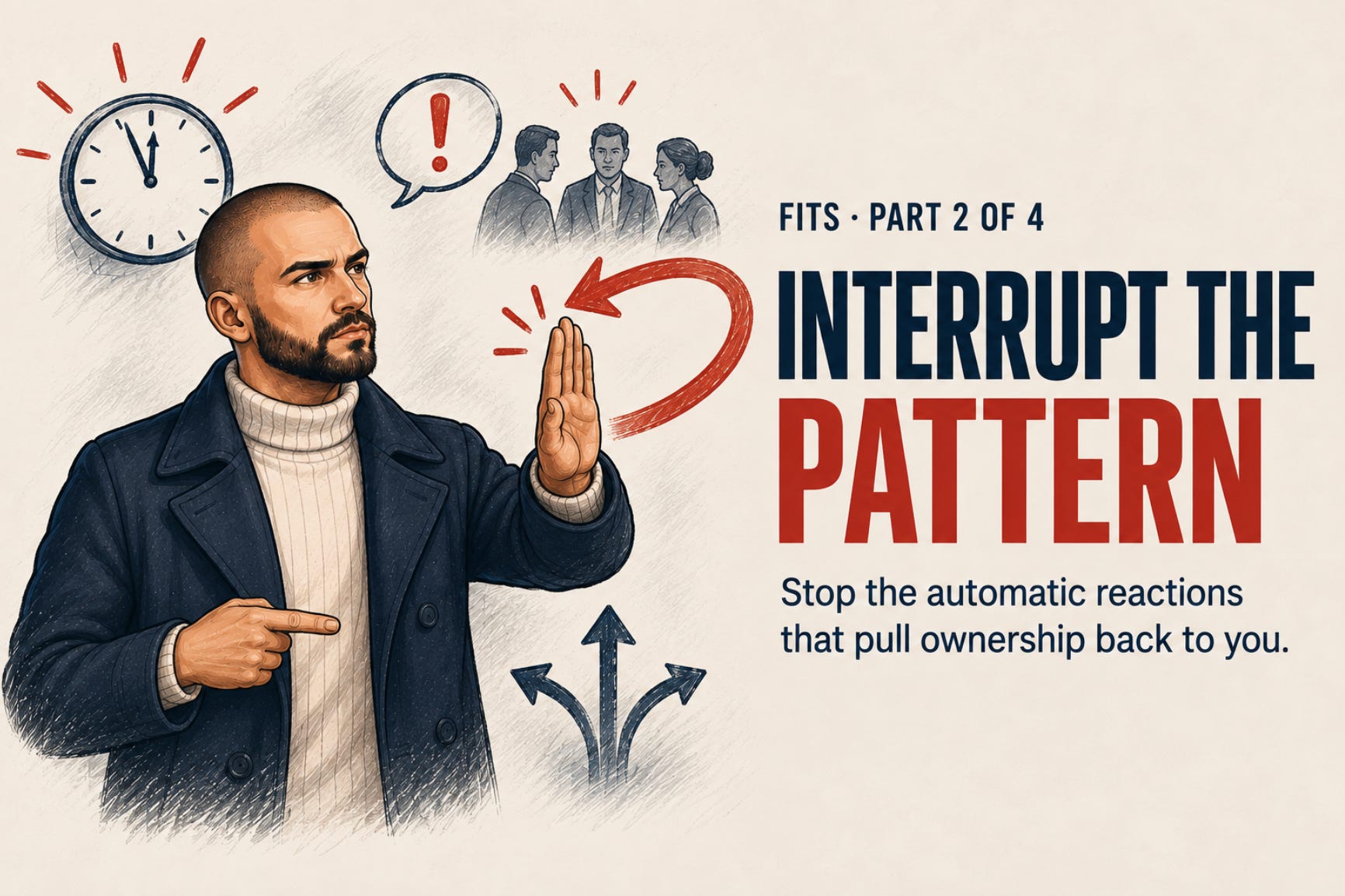
FITS Framework, Part 2 of 4: How to catch and interrupt the automatic response that turns support into takeover.
You already decided that your Team Lead owns the project.
Then they send you a plan. It is reasonable, but not the approach you would have chosen. You can see three things that could be improved immediately.
You intend to leave one comment. Twenty minutes later, you have rewritten part of the proposal, suggested the next steps and added yourself to the follow-up meeting.
The work may now be better.
It also belongs to you again.
This can happen even after you have mapped the dependency clearly. You know which decisions should sit with your managers. You understand that answering every difficult question prevents them from building judgment. You may have promised yourself that you will stay out next time.
Then a familiar trigger appears, and the old response still feels like the useful one.
Awareness helps you recognize the pattern. It does not automatically give you a different response while the situation is unfolding.
That is the work of the second phase of FITS: Interrupt the Pattern.
Where this sits in FITS
FITS is the framework I use to help tech founders and senior engineering leaders get out of the dependency loop:
F: Find the Dependency. Map where and why work keeps returning to you.
I: Interrupt the Pattern. Change the reactions and routines that keep reinforcing it.
T: Transfer Ownership. Move decisions and responsibilities to the right level, with clear boundaries and accountability.
S: Stay Out of the Loop. Maintain visibility and standards without taking ownership back under pressure.
In Part 1, we made the dependency visible. We looked at the decisions, meetings, approvals and escalations that still depended on the leader. We also identified how the leader’s responses taught the organization to keep returning.
Part 2 focuses on changing that response.
We are not yet redesigning every decision boundary or transferring entire areas of ownership. First, the leader needs to stop automatically reinforcing the old system. Otherwise, any new delegation model will collapse the first time something becomes uncomfortable.
The pattern begins before you step in
Taking over is only the visible part of the pattern.
The full sequence usually looks more like this:
Something triggers you. A weak recommendation, a slow decision, a question you can answer quickly or an approach different from yours.
You give it meaning. “They are not on top of this.” “This could reflect badly on us.” “If I do not act now, we will lose control.”
Pressure rises. You feel urgency, anxiety, frustration or responsibility.
You make the familiar move. You answer, correct, join, approve, rewrite or take the decision.
You get an immediate reward. The problem moves, uncertainty falls and everyone feels safer.
The organization learns. When uncertainty appears, bring the problem to you.
The response is easy to justify because it often works in the short term.
You may genuinely be the fastest person in the room. Your judgment may be better. Your intervention may protect an important client or prevent expensive rework. The dependency grows through successful interventions as easily as through poor ones.
That is why simply telling yourself to “delegate more” rarely changes much. The old behavior keeps receiving evidence that it is useful.
Find your specific trigger
Different leaders are pulled back into the loop by different signals.
One leader can tolerate a slower decision but reacts quickly to a drop in quality. Another can accept mistakes but cannot tolerate an unhappy stakeholder. A founder may step in when progress becomes difficult to see. A Director may remain calm until two managers disagree and the conflict starts affecting delivery.
Common triggers include:
a recommendation that feels incomplete;
silence or slower progress than you expected;
a decision different from the one you would make;
visible uncertainty from a manager or Team Lead;
someone contacting you directly instead of going through the current owner;
a mistake you believe you could have prevented;
the possibility that standards will drop while you watch.
The trigger alone does not determine the response. The meaning you attach to it matters just as much.
When a manager hesitates, you may interpret that as a lack of capability. When someone chooses a different approach, you may see unnecessary risk. When people ask for your view, you may conclude that seniority requires you to provide the answer.
Those interpretations can be correct. They can also be old assumptions moving faster than the evidence.
In coaching, we slow down one recent situation and examine it closely:
What happened before you became involved?
What did you notice first?
What did you assume would happen if you stayed out?
What did you feel responsible for protecting?
What did you do next?
What immediate relief did your involvement create?
What did the other person stop owning after you entered?
We are looking for the moment when support became takeover.
The four roles that pull leaders back in
In Part 1, I introduced four common ways leaders enter the dependency loop: the Rescuer, the Expert, the Quality Protector and the Responsible Leader.
Each role needs a slightly different interruption.
The Rescuer
The Rescuer sees someone struggling and removes the difficulty. The intervention may feel empathetic, especially when the person is overloaded or stuck.
The interruption begins by asking what kind of support is actually needed:
“What do you need from me right now: context, challenge, cover or a decision?”
Helping someone think is different from absorbing the problem for them.
The Expert
The Expert sees the answer early. Watching others spend an hour reaching something you can see in five minutes feels wasteful.
The interruption is to delay your solution long enough to inspect their thinking:
“Before I share my view, what do you recommend, and which trade-offs are you accepting?”
The goal is not to hide useful expertise. It is to use that expertise to improve someone else’s judgment rather than replace it.
The Quality Protector
The Quality Protector anticipates rework, client dissatisfaction or damage to the team’s reputation. Differences in approach can quickly feel like declining standards.
The interruption is to separate a different method from an unacceptable outcome:
“Which standard is genuinely at risk here, and which part is simply different from how I would do it?”
If the standard exists mainly in your head, the longer-term work is to make it visible. For now, the first step is noticing when preference is being treated as risk.
The Responsible Leader
The Responsible Leader equates accountability with involvement. If the outcome ultimately reflects on you, stepping back can feel careless.
The interruption is to identify the unique contribution your role requires:
“What value can only I add here, and what ownership would I remove by adding more?”
You can remain accountable for the system without becoming the owner of every decision inside it.
The interruption sequence
An interruption needs to be simple enough to use while Slack is active, a meeting is moving and someone is waiting for your answer.
I use five steps.
1. Notice the signal
Learn your earliest reliable sign that you are about to take over.
It may be a thought such as, “This will be faster if I do it.” It may be the urge to open a document and start rewriting. It may be tension, impatience or the feeling that nobody else sees the seriousness of the situation.
The earlier you notice it, the more choices you still have.
2. Name what the situation activates
Ask yourself what you are trying to protect or regain:
speed;
quality;
predictability;
the other person from failure;
your sense of usefulness;
your own sense of control.
Naming it reduces the chance that every uncomfortable situation will be treated as a reason to get involved.
3. Separate risk from discomfort
Before stepping in, assess the situation:
Is the decision reversible?
How large is the potential impact?
How quickly would we detect a mistake?
Does the current owner have enough context and capability?
Can a shorter feedback loop contain the risk?
A reversible decision with visible feedback rarely needs extensive involvement. If the stakes are genuinely high, the response needs an additional protocol. That belongs to the final phase of FITS.
4. Ask before you answer
Do not turn every conversation into a coaching performance. One or two direct questions are usually enough:
“What do you recommend?”
“What trade-offs do you see?”
“How would this fail?”
“What would you do if I were unavailable?”
“Which part of this decision do you believe requires me?”
These questions reveal whether the person needs information, challenge, authority or reassurance. They also prevent uncertainty from automatically becoming your problem.
5. Return the next move
End the interaction with ownership in a clear place.
You might say:
“You own the decision. Send me the recommendation and trade-offs by 2 p.m., and I will challenge the reasoning.”
Or:
“Proceed with your approach. Escalate again only if the cost, deadline or client impact crosses the boundary we discussed.”
The important question is simple: Who leaves the conversation owning the next move?
If the answer is still you, the pattern was not interrupted.
Interruption does not mean withdrawal
Leaders sometimes overcorrect when they first see the dependency. They stop attending meetings, reply to every question with another question or tell the team to “show more ownership.”
That creates distance without creating capability.
Interrupting the pattern does not require you to watch preventable failure in silence. It means choosing your involvement instead of entering automatically.
Sometimes the team needs context that only you have. Sometimes a new manager needs a tighter feedback loop. Some decisions genuinely belong to your role. When that is true, contribute directly and explain why.
The distinction is between adding what only you can add and absorbing what someone else needs to learn to carry.
What about genuinely critical situations?
This phase deliberately focuses on the repeated, everyday moments that create dependency: answering too quickly, correcting work, joining conversations unnecessarily, becoming the final approval and absorbing problems that someone else could continue thinking through.
Critical incidents, severe delivery risk and high-stakes escalations require a different level of involvement. By that point, interrupting an impulse is only part of the challenge. The leader also needs to protect an ownership system that has already been deliberately transferred.
We will address that in the final phase of FITS: Stay Out of the Loop.
How this phase works in coaching
We work with current leadership situations, not hypothetical exercises or hours of homework.
The phase has three practical parts:
Reconstruct a recent takeover. We map the trigger, interpretation, pressure, response, immediate reward and effect on ownership.
Design a specific interruption. We choose one repeated loop and create a response the leader can realistically use inside it.
Test it in live work. The leader applies it in actual meetings, decisions or escalations, then we review what happened and adjust.
The between-session tracking can stay small. For one week, record only:
the trigger;
the urge you noticed;
what you did instead;
who owned the next move;
what happened afterward.
We are not looking for perfect restraint. We are building the ability to recognize the choice while the situation is still happening.
A practical experiment for this week
Choose one dependency from your Part 1 map. Do not try to change every interaction.
For the next five working days, use these questions whenever that dependency returns:
What am I about to do automatically?
What specific risk am I responding to?
What value can only I add?
What question would help the current owner think further?
Who will own the next move when this conversation ends?
Then watch what changes.
You may initially get slower answers. People may look surprised when you do not resolve the issue immediately. Some may return with the same question phrased differently. That does not automatically mean the experiment failed. The organization is testing whether the old route to certainty is still available.
Consistency matters more than one perfect coaching conversation.
How you know the pattern is changing
This phase is working when:
you notice the trigger before you give the answer;
fewer questions receive an immediate solution from you;
you can tolerate a different approach without treating it as lower quality;
managers begin bringing recommendations and trade-offs;
routine uncertainty no longer leads to automatic takeover;
you can leave a conversation after adding context without owning the next action.
That still does not guarantee that ownership has moved permanently.
Interrupting your response creates space. The team now needs clarity about what belongs in that space: which decisions they own, what outcome is expected, where the boundaries are and when escalation is appropriate.
That is the third phase of FITS: Transfer Ownership.
I work 1:1 with tech founders and senior engineering leaders who can see the dependency loop but still find themselves answering, correcting and stepping into work that should no longer depend on them.
In one coaching engagement, a leader removed three recurring meetings, reclaimed more than six hours a week and created room for roadmap and modernization work. The calendar changed after the interactions inside those meetings changed.
If you know where your organization depends on you but struggle to respond differently in the moment, reply with LOOP. We can identify the pattern that keeps pulling you back in.