

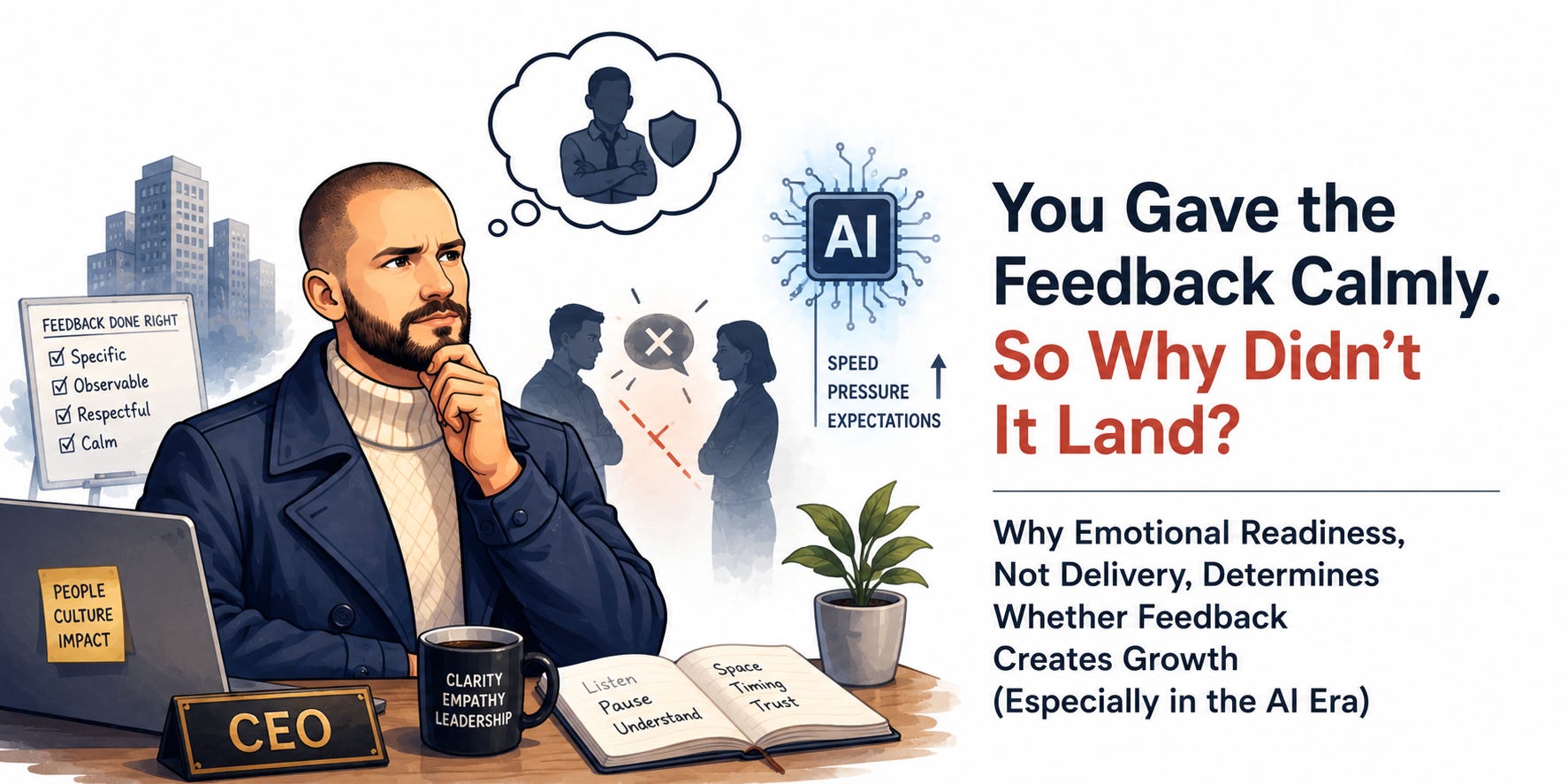
Most leaders eventually run into the same frustrating moment.
You prepare carefully for a difficult conversation.
You stay calm.
Measured.
Respectful.
You explain the issue clearly.
You focus on observable behavior.
You avoid blame.
You genuinely try to help.
And somehow…
the conversation still leaves tension behind.
The person becomes defensive.
Withdrawn.
Cold.
Or maybe even worse:
They nod through the whole conversation…
…but nothing actually changes afterward.
And now you’re left sitting there thinking:
“I handled that well.”
So why did it feel so bad?
Why didn’t it land?
This is one of the hardest parts of leadership that almost nobody prepares CEOs for:
Sometimes feedback fails even when it was delivered correctly.
And the higher you climb, the more emotionally expensive that becomes.
Because at your level, feedback is not an occasional thing.
It’s constant.
You’re trying to improve:
communication,
ownership,
decision-making,
alignment,
execution,
culture.
You’re carrying pressure from every direction.
And eventually you realize something uncomfortable:
Giving feedback properly does not guarantee it will be received properly.
That realization changes how you lead.
The Leadership Advice That Sounds Right… But Feels Incomplete
Most leadership advice focuses heavily on delivery.
Stay calm.
Be specific.
Use frameworks.
Avoid judgment.
Focus on behavior, not personality.
And honestly?
That’s good advice.
But I think it misses something deeper.
Because feedback is not just information.
It’s emotional interpretation.
People don’t receive feedback logically first.
They receive it emotionally first.
Especially under pressure.
Especially inside fast-moving companies.
Especially when uncertainty already exists underneath the surface.
And that’s where many leaders unknowingly struggle.
Not because they communicate badly.
But because they underestimate the emotional environment surrounding the conversation.
A Founder Conversation I Still Think About
I remember speaking with a founder who was frustrated with one of his senior leaders.
The complaint itself was valid.
The leader had become increasingly reactive during meetings.
Interrupting people.
Defending ideas too quickly.
Creating subtle tension whenever someone challenged him.
The founder approached the conversation thoughtfully.
Private meeting.
Calm tone.
No public embarrassment.
And he said something close to:
“I’ve noticed that when someone pushes back on an idea, your response becomes very fast and defensive. I think it’s starting to affect how openly people speak in meetings.”
Honestly?
That’s fairly emotionally intelligent feedback.
But the reaction came immediately.
“That’s not true.”
“I’m just trying to move things forward.”
“If people can’t handle direct conversations, that’s not my problem.”
The atmosphere changed instantly.
And the founder’s first instinct was the same instinct most leaders have:
Explain harder.
Clarify intent.
Give more examples.
Convince him.
And this is the exact moment where many leadership conversations quietly collapse.
Because once someone feels psychologically threatened, they stop listening for insight.
They start listening for danger.
The Mistake Nobody Notices in Real Time
One of the biggest mistakes leaders make is assuming defensiveness means the feedback was unclear.
So they push harder.
More explaining.
More examples.
More persuasion.
But here’s the problem:
The more emotionally pressured someone feels, the less reflective they become.
And this gets amplified even more when companies are moving fast.
Which honestly is where many companies are right now.
AI is accelerating expectations everywhere.
Faster shipping.
Faster decisions.
Faster iteration.
Faster comparison.
Everyone feels it.
Founders feel pressure from the market.
Leadership teams feel pressure from founders.
Teams feel pressure from leadership.
And eventually all of that pressure leaks into communication.
Sometimes very subtly.
Through tone.
Pacing.
Interruptions.
Impatience.
Micro reactions.
You think you’re simply giving “clear feedback.”
But the other person may already feel:
overwhelmed,
replaceable,
behind,
or afraid of disappointing you.
So even calm feedback lands emotionally heavier than you intended.
The Hard Truth About Feedback
I think this is one of the hardest truths for leaders to accept:
You cannot force self-awareness into someone.
No matter how correct you are.
No matter how calm you are.
No matter how thoughtful your delivery is.
You can invite reflection.
You can create safety.
You can plant a seed.
But you cannot force readiness.
And trying to force it usually damages the relationship faster than the original issue itself.
That’s the paradox.
The stronger your need for them to understand immediately…
…the less likely understanding becomes.
What I Personally Got Wrong Earlier in My Career
Earlier in my leadership career, I believed clarity solved defensiveness.
If someone resisted feedback, I thought I simply needed to explain it better.
And honestly?
Sometimes that worked.
But many times, I was unknowingly increasing emotional pressure while believing I was improving communication.
Because once people feel cornered, something shifts internally.
They stop reflecting.
They start protecting identity.
You’ll notice it immediately:
More justification.
More intellectualizing.
More subtle blame shifting.
More defensiveness.
Or complete emotional shutdown.
And ironically, the harder you push…
…the further insight moves away.
Especially with highly intelligent people.
Especially with founders, senior engineers, and leaders.
Because smart people are very good at defending internal logic.
Very good at explaining themselves.
Very good at protecting self-image without realizing it.
Which means feedback can accidentally become identity conflict instead of discussion.
And identity is emotional territory.
Not rational territory.
Sometimes They’re Not Resisting the Feedback
This is the part I think changed my leadership the most.
Sometimes people are not resisting your feedback.
They’re resisting the pressure surrounding it.
That distinction matters enormously.
Because once you understand that, your goal changes.
You stop asking:
“How do I make them understand?”
And start asking:
“How do I create conditions where understanding becomes possible?”
That creates a completely different conversation.
Less force.
More space.
More patience.
Ironically, that’s usually what increases reflection.
Why Leaders Keep Pushing Anyway
I think many leaders, especially at the top, unknowingly carry a hidden fear into feedback conversations:
“If they don’t understand this right now, nothing will improve.”
So they keep pushing.
Not because they’re controlling people.
Because internally they’re trying to reduce uncertainty.
Trying to regain clarity.
Trying to fix tension quickly.
But growth rarely happens under emotional compression.
Reflection needs psychological space.
Especially for strong personalities.
Especially for high performers.
Especially for leaders.
One of the Most Emotionally Intelligent Things a Leader Can Do
Pause.
Not withdraw.
Not avoid accountability.
Not become passive.
Pause.
Because timing matters.
Sometimes insight arrives later.
Hours later.
Days later.
Weeks later.
I’ve had situations where someone resisted feedback completely in the moment…
…and later came back saying:
“I’ve actually been thinking about what you said.”
That only happened because the conversation was allowed to breathe.
Not because pressure forced the realization.
What Emotional Intelligence Actually Looks Like at the Top
A lot of people think emotional intelligence means saying things gently.
I don’t think that’s true.
At the CEO level, emotional intelligence is much more about emotional regulation.
Can you stay grounded when someone reacts badly?
Can you tolerate not being understood immediately?
Can you resist the urge to force alignment?
Can you create safety instead of pressure?
That’s the real work.
Not communication tricks.
Not memorized frameworks.
Not perfect phrasing.
Those things help.
But leadership conversations are emotional environments first.
Information second.
AI Is Quietly Making This Harder
I don’t think AI is replacing leadership.
But I do think it’s amplifying leadership psychology.
Because speed changes emotional dynamics.
Everything moves faster now.
Pressure accumulates faster.
Expectations rise faster.
Decisions happen faster.
Tension spreads faster.
And when leaders operate under constant acceleration, they become more vulnerable to emotional reactivity without realizing it.
Not because they’re weak.
Because they’re human.
Which means the ability to regulate yourself under pressure becomes even more valuable now.
Not less.
The Shift That Changed How I Think About Feedback
The older I get, the more I believe leadership is deeply connected to nervous systems.
Not just strategy.
Not just execution.
Not just intelligence.
Nervous systems.
A regulated leader creates openness.
A reactive leader creates protection.
And protection changes how people communicate.
That’s why some organizations slowly become politically filtered over time.
People stop speaking honestly not because they’re dishonest…
…but because emotionally they no longer feel safe risking friction.
And that can happen even under good people.
Even under thoughtful founders.
Even inside successful companies.
A Simple Reminder I Think More Leaders Need
Sometimes you can do everything “right”…
…and the feedback still won’t land immediately.
That does not automatically mean:
you failed,
they’re impossible,
or the relationship is broken.
Sometimes people simply aren’t ready yet.
And one of the most emotionally intelligent things you can do in that moment is stop trying to force insight.
Not forever.
Just long enough for the conversation to breathe.
Because leadership is not about winning the interaction.
It’s about building enough trust for truth to eventually be heard.
And honestly?
That’s much harder than giving feedback correctly in the first place.