

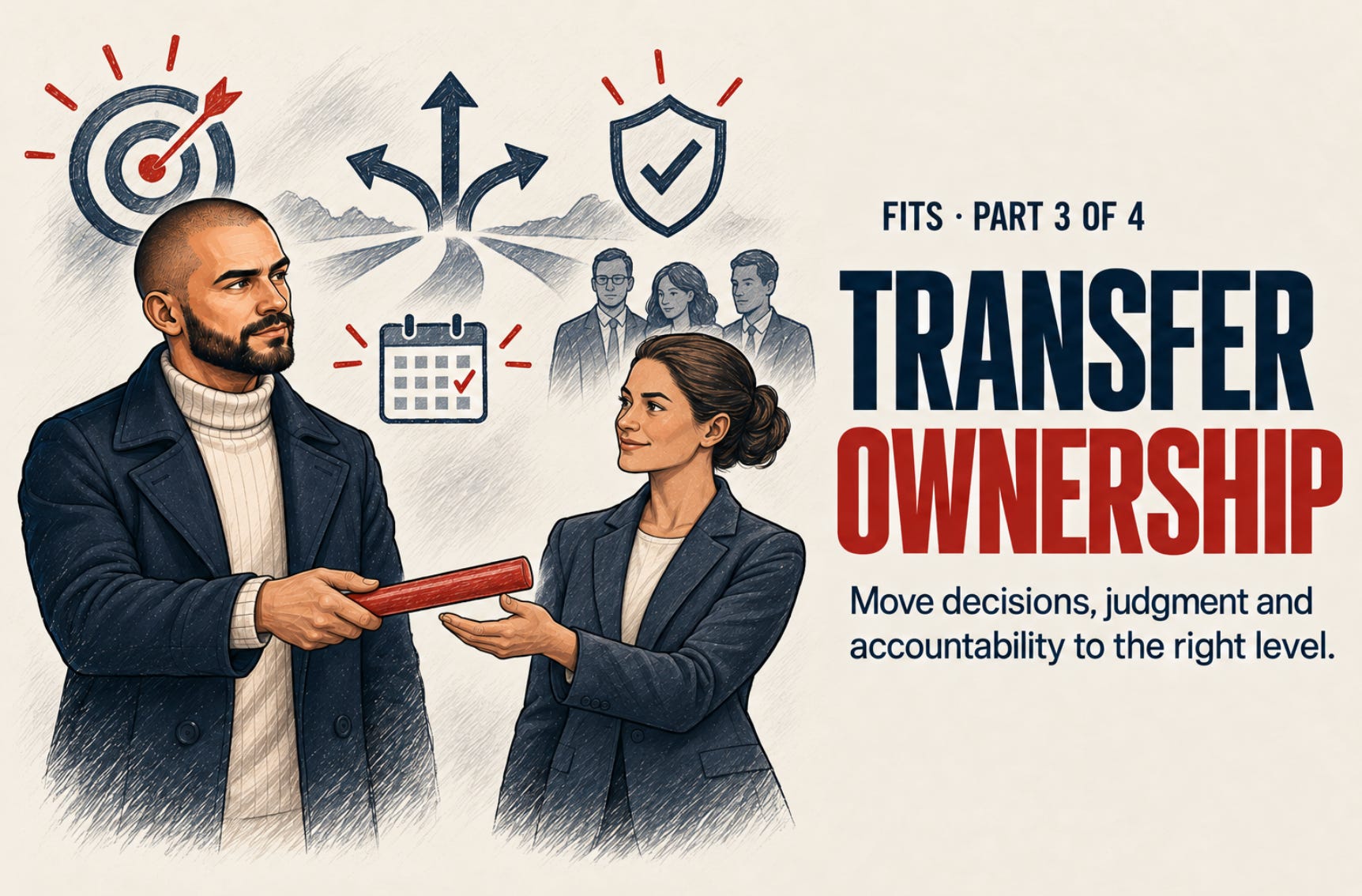
FITS Framework, Part 3 of 4: How to transfer real ownership, not just tasks, without losing visibility or lowering your standards.
You stopped giving the answer immediately.
When your Team Lead brought you a problem, you asked for a recommendation. You challenged the trade-offs without rewriting the plan. They left the conversation owning the next move.
That is progress.
Then the next important decision arrives, and everyone still looks at you.
The team can execute without you. Your managers can run the meetings. They may even bring stronger proposals than before.
But the real authority still sits one level higher.
Plans need your approval. Risks need your interpretation. Stakeholder messages need your final check.
You interrupted the old pattern, but you have not yet created a new ownership system.
Space alone does not create ownership. Without clarity, it creates hesitation.
That is the work of the third phase of FITS: Transfer Ownership.
Where this sits in FITS
FITS is the framework I use to help tech founders and senior engineering leaders get out of the dependency loop:
F: Find the Dependency. Map where and why work keeps returning to you.
I: Interrupt the Pattern. Change the reactions and routines that keep reinforcing it.
T: Transfer Ownership. Move decisions and responsibilities to the right level, with clear boundaries and accountability.
S: Stay Out of the Loop. Maintain visibility and standards without taking ownership back under pressure.
Part 1 showed us where the dependency lived.
Part 2 changed the leader’s automatic response to it.
Part 3 builds the operating model that replaces it.
Delegating work is not the same as transferring ownership
A leader can delegate almost every task and remain the bottleneck.
Someone else prepares the plan, runs the project and coordinates the team. The leader still decides whether the plan is good enough, resolves the hardest trade-offs and carries the stakeholder relationship whenever something becomes uncertain.
Execution moved.
Judgment did not.
Real ownership requires more than a task. It requires:
a clear outcome;
authority to make relevant decisions;
enough context and capability to use that authority;
boundaries that define when the decision moves elsewhere;
accountability for what happens next.
If one of those pieces is missing, work tends to travel back upward.
Without authority, the new owner keeps asking for approval.
Without context, they make narrow decisions.
Without capability, autonomy becomes abandonment.
Without boundaries, both sides remain unsure who should act.
Without accountability, the leader quietly becomes the safety net.
Transfer Ownership means designing all five pieces deliberately.
Step 1: Choose what you are actually transferring
“Be more proactive” is not an ownership transfer.
Neither is “take more responsibility for delivery.”
These phrases describe a hope, not a defined area of authority.
Start with one recurring responsibility from the dependency map you created in Part 1.
It might be:
release readiness for one product area;
technical direction for a service or platform;
delivery communication with a stakeholder;
hiring for a specific team;
coordination between two engineering groups;
performance and development of a Team Lead;
prioritisation inside an agreed portfolio boundary.
Describe the ownership as something another person can recognise and act on.
Then ask:
What outcome am I expecting them to own?
Which decisions repeatedly come back to me inside this area?
Which of those decisions should move with the responsibility?
What would I still own after the transfer?
How will both of us know that the transfer is working?
Ownership becomes real when the person can point to a defined area and say:
“This is mine to move forward.”
Step 2: Match the level of autonomy to readiness
Transferring ownership does not mean giving the same amount of freedom to everyone.
A strong engineer can be ready to own technical decisions in a familiar domain and still need close support when navigating a difficult stakeholder.
An experienced Engineering Manager may independently run delivery while needing more context before making portfolio trade-offs.
Readiness is specific to the responsibility, not the person’s title.
I look at two things:
Capability: Do they have the knowledge, judgment and experience required here?
Commitment: Do they have the confidence and willingness to carry the responsibility when it becomes uncomfortable?
That creates four practical levels of support.
1. Give direction
Use this when the person lacks critical context or experience.
Define the steps, quality bar and short check-in points clearly. They can still own execution, but pretending they are ready for broad decision authority would create avoidable failure.
2. Think together
Use this when capability is developing.
Ask for their recommendation, examine options together and explain the reasoning behind important constraints.
The leader contributes more context, while the other person increasingly owns the analysis and next move.
3. Support the decision
Use this when the person has the capability but still seeks reassurance.
Let them decide, then provide challenge, confidence or organizational cover.
The support should strengthen their authority rather than become a hidden approval step.
4. Delegate the outcome
Use this when capability and commitment are both strong.
Agree on the outcome, guardrails and visibility. The person owns the decisions inside those boundaries.
The goal is progression. Feedback loops should widen as judgment becomes more reliable.
Step 3: Define the outcome before the method
Leaders often transfer a responsibility by explaining exactly how they would handle it.
That can produce high-quality imitation. It rarely produces independent ownership.
Instead, clarify:
Why this matters. What larger business or organizational outcome does it support?
What success looks like. Which result, behaviour or quality signal matters?
What is non-negotiable. Which constraints must be respected?
What can change. Where is the new owner free to choose a different approach?
Who is affected. Which teams or stakeholders need to be involved?
When you will review progress. What visibility does the leader genuinely need?
For example, “Own our release process” leaves too much room for interpretation.
A clearer transfer sounds like this:
“You own release readiness for this product area. Success means that scope, quality risk and stakeholder expectations are clear before each release. You can change the process and decide whether we are ready to ship. Consult Security when their controls are affected, and escalate to me if the release changes a contractual commitment or creates material risk across another portfolio.”
The outcome is clear.
The method still belongs to the owner.
Step 4: Make the decision boundaries explicit
Many delegation problems are decision-rights problems in disguise.
The team knows what work to do but does not know which choices it can make without the leader.
Every significant decision then becomes an informal negotiation.
For each ownership area, separate decisions into four categories.
Decide independently
These decisions belong entirely to the new owner. They do not require permission or a final review.
Consult before deciding
The owner still decides but gathers input from people whose context or work will be affected.
Recommend for a leader’s decision
These decisions genuinely belong to the leader’s role.
The team owns the analysis, options and recommendation. The leader owns the final choice.
Inform after deciding
The decision belongs to the owner, while the leader needs visibility because of wider organizational impact.
This prevents “keep me in the loop” from quietly becoming “wait for my approval.”
The categories should reflect roles and expertise.
A Head of Engineering may own organization design, budget allocation and overall technical direction.
An architect, DevOps lead or Engineering Manager should still own decisions inside their domain when they have the required context and authority.
Seniority does not make the leader the best decision-maker for every subject.
It makes the leader responsible for ensuring that the decision sits with the right person.
Step 5: Transfer judgment, not just permission
Giving someone authority does not automatically give them the judgment to use it well.
That capability grows by making the thinking visible.
When reviewing a decision, ask the current owner to walk through:
What problem are we actually solving?
What does a good outcome require?
Which options did you consider?
What are the important trade-offs?
What information or perspective might be missing?
What do you recommend?
How could this fail?
Your role is to challenge the reasoning, add context they could not reasonably have and surface risks they may not yet recognise.
Then let their decision remain theirs.
If every review ends with your preferred answer, people learn to reverse-engineer your opinion.
They become better at anticipating you, not necessarily better at making decisions.
Independent judgment does not require identical thinking. It requires reasoning strong enough to trust, even when the conclusion differs from yours.
Step 6: Build a feedback loop that can widen
Ownership does not need to move from full control to complete autonomy in one step.
The feedback loop can begin tight and widen as evidence accumulates:
review the first few decisions together;
move to a weekly review of outcomes and risks;
review only at agreed milestones;
eventually discuss exceptions rather than routine activity.
The important part is what happens inside the check-in.
A useful feedback loop examines outcomes, decisions, risks and learning. It does not require the leader to direct every action or approve what happens next.
Agree in advance what will allow the loop to widen:
repeated sound decisions;
risks identified early;
clear stakeholder communication;
commitments followed through;
mistakes detected and corrected without rescue;
escalation used within the agreed boundaries.
Without those criteria, close support can continue indefinitely simply because it feels safer.
Step 7: Define accountability without becoming the safety net
Ownership includes what happens after the decision.
The owner communicates it, follows the outcome, adapts when new information appears and explains what was learned when something goes wrong.
The leader should not silently complete the parts that were missed.
When the outcome falls short, avoid jumping straight to correction. Review the ownership process:
Which signal did we miss?
Which assumption turned out to be wrong?
Was the boundary unclear?
Did the person lack context or capability?
Did they recognise the risk but escalate too late?
What needs to change before the next decision?
Accountability should improve judgment.
Used mainly as punishment, it teaches people to reduce risk by returning decisions upward.
The Ownership Transfer Contract
In coaching, we turn the transfer into a simple written agreement.
It does not need to become a heavy governance document.
Use this structure:
Ownership area: What responsibility is moving?
Owner: Who is accountable for moving it forward?
Outcome: What result should they create, and why does it matter?
Independent decisions: What can they decide without consultation or approval?
Consultation points: Whose input must they gather before certain decisions?
Leader decisions: What remains explicitly with the leader?
Guardrails: Which constraints, principles or standards are non-negotiable?
Escalation triggers: Which changes in cost, timing, scope, quality or organizational impact require escalation?
Visibility: What information does the leader need, in what form and how often?
Feedback-loop progression: What evidence will allow check-ins to become less frequent?
Transfer complete when: What would prove that this area no longer depends on the leader?
The contract gives both sides something more useful than “I trust you.”
It explains what that trust allows the person to do.
Common ways ownership transfer fails
The task moves, but approval stays
The person does all the work and still needs the leader to confirm every meaningful choice.
Authority moves without context
The leader expects good decisions while keeping the business background, stakeholder dynamics or strategic constraints at the top.
Autonomy ignores readiness
The person receives broad ownership before developing the judgment required to carry it.
Standards remain invisible
The leader says, “You own it,” then corrects the result against expectations that were never made explicit.
Two people continue to own the same outcome
The leader and the new owner both attend, decide and communicate.
Everyone else learns to wait until they agree.
The first mistake ends the transfer
One poor decision becomes evidence that the leader stepped back too early.
Ownership returns before the team can learn from the miss.
Stepping back becomes disappearing
The leader removes involvement without providing context, boundaries, feedback or support.
These failures often look like evidence that delegation does not work.
They usually show that only part of ownership moved.
How this phase works in coaching
We work with one real responsibility that currently depends on the leader.
The phase has five practical parts:
Select the ownership area. Choose a dependency with enough value and repetition to matter.
Assess readiness. Identify the person’s current capability and commitment for this specific responsibility.
Build the contract. Define the outcome, decision boundaries, guardrails, escalation triggers and visibility.
Apply it in live work. Use an upcoming decision, meeting or stakeholder interaction to make the transfer real.
Review and widen. Examine the first cycles, add missing context and reduce involvement as judgment develops.
This is not a generic delegation exercise.
The transfer happens inside the work the leader already needs to deliver.
A practical transfer for this week
Choose one responsibility that someone else should own more fully.
Write down:
The outcome they should own.
Three decisions they can make independently.
One decision that still belongs to you.
Two conditions that should trigger escalation.
The visibility you need without becoming an approval step.
The first date on which you will review the reasoning and outcome.
The evidence that would allow you to widen the feedback loop.
Then discuss it with the person and ask them to explain the agreement back to you.
The gaps in their explanation will reveal the boundaries that still exist only in your head.
How you know ownership is moving
This phase is working when:
the owner can explain the outcome and why it matters;
they know which decisions they can make without permission;
recommendations arrive with reasoning and trade-offs;
escalation happens because a defined boundary was crossed, not because uncertainty appeared;
your check-ins focus on outcomes and risks rather than activity;
the feedback loop becomes wider as capability grows;
work continues when you are unavailable.
At that point, ownership is no longer an intention.
It has become part of how the organization operates.
Then comes the hardest test.
A deadline slips. A critical incident happens. A client escalates. The decision has consequences large enough that taking control feels completely justified.
Can the ownership system survive that moment?
That is the final phase of FITS: Stay Out of the Loop.
I work 1:1 with tech founders and senior engineering leaders who have delegated work but remain the real decision-maker behind it.
In one coaching engagement, a leader removed three recurring meetings, reclaimed more than six hours a week and created room for roadmap and modernization work. The change came from making ownership clearer and supporting the team without remaining inside every decision.
If work has moved away from you but decisions, approvals and difficult problems still return, reply with LOOP. We can identify the first ownership area that needs to move for real.