

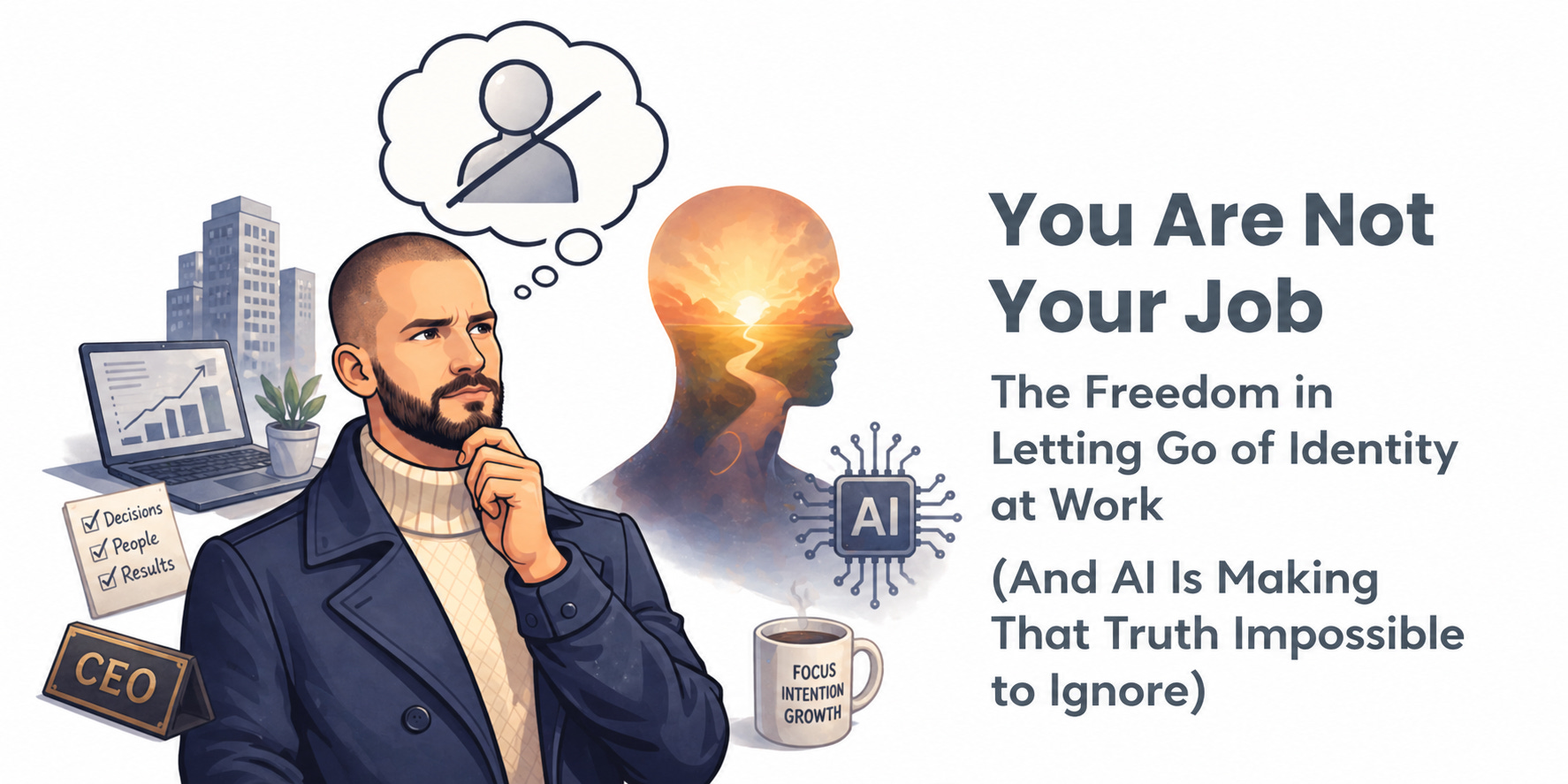
I used to walk into work like I had something to prove.
Not in an obvious way.
Not loud. Not arrogant.
Quietly.
Every decision carried weight.
Every reaction felt like it mattered more than it should.
Every piece of feedback lingered longer than it deserved.
When things went well, I felt sharp.
Capable. In control.
When they didn’t…
Something in me tightened.
Not because the outcome was bad.
But because it said something about me.
And that’s the part most people don’t talk about.
The Hidden Equation
At some point, without realizing it, you start running this equation:
My performance = My worth
It doesn’t show up as a belief.
It shows up as a reaction.
You overthink decisions.
You replay conversations.
You take tone personally.
You feel the need to prove yourself… even when no one asked you to.
And the higher you go, the more subtle it becomes.
Especially if you’re leading.
Especially if you’re a founder.
A CTO.
A CEO.
Because now it’s not just your work.
It’s your company.
Your people.
Your decisions.
Your identity expands…
…and traps you at the same time.
AI Didn’t Create Pressure
It Exposed It
Everyone is talking about AI replacing engineers.
But very few are talking about what it’s doing to leaders.
Because the pressure didn’t start with AI.
AI just removed the illusion of stability.
Every few weeks:
A new model.
A new capability.
A new expectation.
Faster decisions.
Less certainty.
Higher stakes.
And suddenly…
You’re not just leading a company.
You’re leading in an environment where:
Information is infinite
Opinions are louder
And “being wrong” is more visible than ever
So what do most leaders do?
They tighten their grip.
They try to be more certain.
More decisive.
More in control.
But underneath that…
There’s something else.
Fear of being exposed.
Not as incompetent.
But as not enough.
The Subtle Trap of Over-Identification
It doesn’t start as ego.
It starts as pride.
“I care about my work.”
“I take responsibility.”
“I want to do this right.”
And that’s good.
Until it becomes identity.
“I’m the one who always delivers.”
“I’m the calm one under pressure.”
“I’m the leader people trust.”
Now you’re not just doing the role.
You’re protecting it.
And that’s where things shift.
Because now…
When something goes wrong,
you don’t just feel frustration.
You feel threatened.
What It Looks Like in Real Life
You don’t notice it immediately.
It shows up in moments.
You get feedback and instantly defend it internally
Someone challenges your decision and you feel irritation, not curiosity
A project slips and you feel embarrassment, not analysis
You avoid certain conversations because they might shake your image
From the outside, you still look composed.
From the inside…
You’re managing your identity.
Not the situation.
You Are Not Your Team’s Performance
This one hits hard.
Because good leaders care.
They take ownership.
They feel responsible.
But there’s a difference between:
Ownership
and
Identification
Ownership says:
“This is mine to improve.”
Identification says:
“This says something about me.”
And once you cross that line…
Everything becomes heavier.
Your team misses a deadline → You feel exposed
Someone underperforms → You question your leadership
Results dip → You start doubting yourself
But here’s the reality most leaders avoid:
There are always variables you don’t control.
Market timing
Product direction
Hidden tech debt
Personal struggles inside your team
Misalignment above you
Random chaos you didn’t see coming
And now, with AI in the mix?
Add to that:
Shifting expectations overnight
Teams experimenting without clarity
Pressure to “use AI” without understanding how
Strategic decisions made on incomplete signals
So if you tie your identity to outcomes…
You’re signing up for instability.
Labels Are Just Comfortable Prisons
People start describing you.
“The calm one.”
“The strategic thinker.”
“The empathetic leader.”
“The one who always knows what to do.”
And it feels good.
Because it gives you certainty.
But here’s the problem:
You start living up to the label…
instead of responding to reality.
You avoid conflict because you’re “the nice one.”
You hesitate to admit uncertainty because you’re “the confident one.”
You overextend because you’re “the reliable one.”
You become predictable.
Rigid.
Safe.
And leadership is none of those things.
Leadership Requires Range
Some days require empathy.
Some require decisiveness.
Some require saying “I don’t know.”
Some require making a call without full information.
And in today’s environment?
That range matters more than ever.
Because AI didn’t simplify leadership.
It removed the luxury of slow thinking.
You still need clarity.
But now you need it faster.
With less data.
And more consequences.
Which means:
You don’t need a fixed identity.
You need adaptability.
The Myth of “Arriving”
There’s a quiet belief many leaders carry:
“I’ll feel confident once I reach the next level.”
Once the company stabilizes.
Once the team performs.
Once decisions get easier.
But that moment never comes.
Because every level introduces:
More ambiguity
More responsibility
More visibility
And now with AI?
More unpredictability.
There is no finish line.
There’s no version of you that becomes immune to:
Doubt
Mistakes
Feedback
Pressure
What changes isn’t the environment.
It’s your relationship to it.
What Actually Improves
Not perfection.
Not certainty.
Not control.
What improves is:
Awareness
Recovery speed
Emotional stability
Decision clarity under pressure
You still feel things.
You just don’t become them.
Your Leadership Is Affected by Everything
This is the part most frameworks ignore.
You are not a static leader.
You are affected by:
Sleep
Stress
Personal life
Energy levels
Context switching
Information overload
And now:
Constant exposure to AI-driven noise.
You read something.
You question your strategy.
You feel behind.
You react faster than you should.
Not because you’re weak.
Because you’re human.
The Real Shift
Letting go of identity doesn’t mean:
Not caring.
Not being responsible.
Not aiming high.
It means:
You stop attaching your self-worth to outcomes.
And that changes everything.
Because now:
Feedback becomes information
Failure becomes signal
Conflict becomes useful
Uncertainty becomes manageable
You lead differently.
Cleaner.
Lighter.
More precise.
How to Let Go Without Letting Down
This is where most people get stuck.
“If I detach… will I lose my edge?”
No.
You lose the noise.
Here’s what actually helps:
Hold things lightly
Care deeply. But don’t cling.
Separate feedback from identity
It’s data. Not judgment.
Stop needing to be right
Focus on getting it right.
Recover faster
Mistakes matter less when you don’t drag them.
Ask better questions
Instead of defending, get curious.
Protect your energy
Not every situation deserves full emotional investment.
A Simple Practice
When something triggers you, pause.
Run this:
Recognize
What am I feeling right now?
Reframe
Am I making this about who I am?
Redirect
What actually helps this situation?
It sounds simple.
But under pressure?
It changes everything.
Why This Matters More Now
Before, you could hide behind process.
Behind time.
Behind hierarchy.
Behind slow cycles.
Now?
AI compresses everything.
Decisions are faster.
Feedback loops are tighter.
Mistakes surface quicker.
So if your identity is tied to being:
Right
Certain
In control
You will feel it.
Constantly.
But if your identity is grounded in:
Learning
Adapting
Responding
You stay stable.
Even when everything else isn’t.
Closing
You are not your job.
You are not your company.
You are not your team’s performance.
You are not your last decision.
You are not your best moment.
You are not your worst one either.
You are someone navigating complexity.
Sometimes well.
Sometimes imperfectly.
But always learning.
And in a world that’s moving faster than ever…
That’s the only thing that actually compounds.
So keep building.
Keep deciding.
Keep leading.
Just don’t confuse the role…
with who you are.