

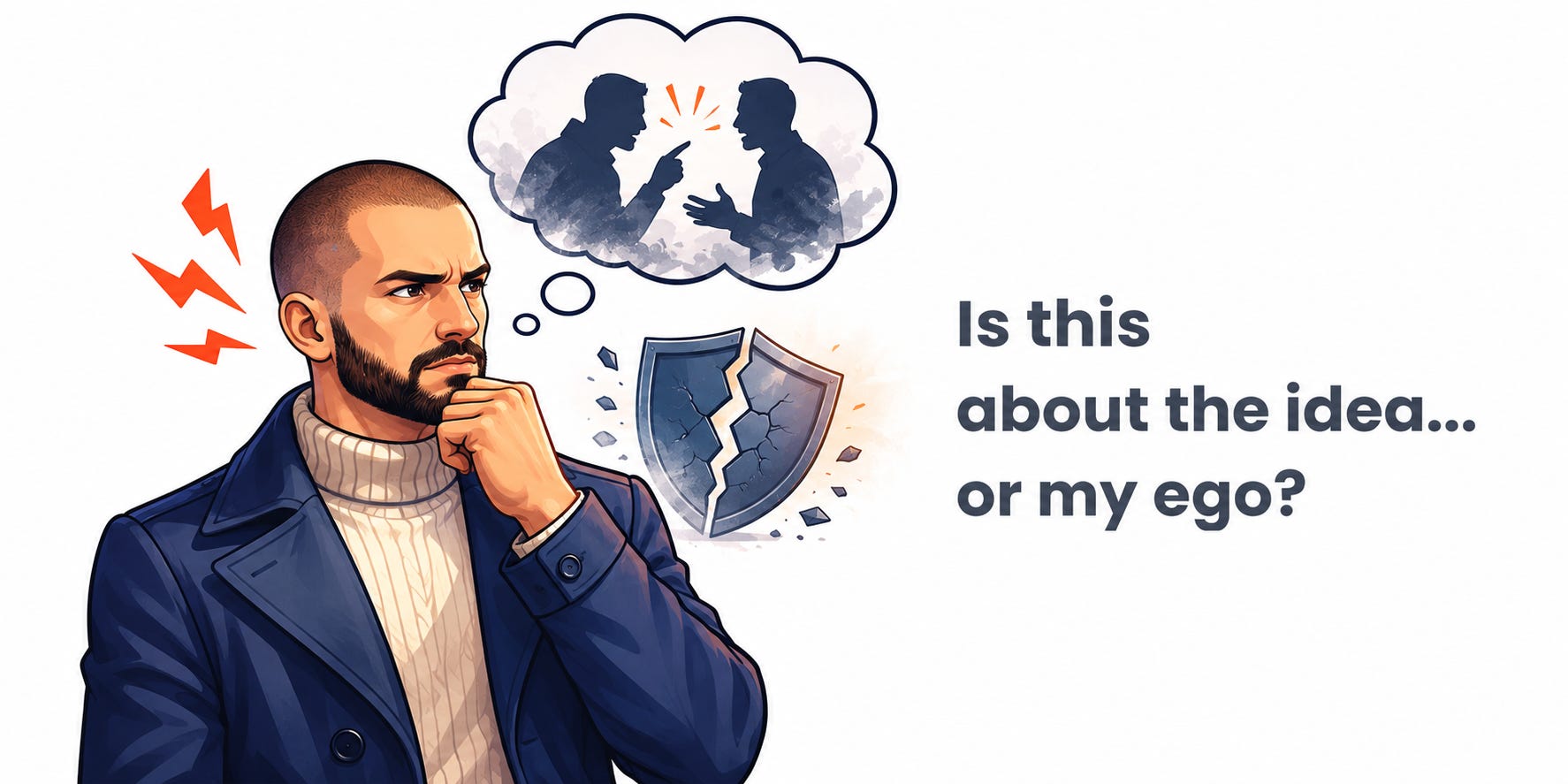
Most leaders say they want honest feedback.
Until it actually arrives.
Not the polished kind.
Not the “quick thought” wrapped in corporate diplomacy.
I mean the real kind.
The kind that questions your judgment in front of other people.
The kind that subtly challenges your authority.
The kind that makes the room go quiet for half a second longer than usual.
That’s usually where emotional intelligence stops being philosophy… and starts becoming biology.
Your chest tightens.
Your jaw locks.
Your brain starts preparing a defense before the other person even finishes speaking.
And suddenly the meeting is no longer about strategy.
It becomes about protection.
Protection of your credibility.
Your competence.
Your status.
Your identity.
What’s fascinating is how quickly intelligent people can become emotionally primitive under pressure.
Especially leaders.
Especially founders.
Especially CEOs.
Because the higher you go, the more conflict starts feeling personal… even when it technically isn’t.
And most leadership advice completely misses this.
It talks about communication styles.
Frameworks.
Listening skills.
Executive presence.
But very little is said about what actually happens internally when someone publicly resists you, challenges you, or makes you feel exposed.
That’s the real work.
Not communication.
Regulation.
Because the most dangerous conflicts at work rarely start from logic.
They start from identity protection.
Where Conflict Actually Comes From
Most workplace conflicts are not about the thing people are arguing about.
The roadmap is rarely the roadmap.
The deadline is rarely the deadline.
The disagreement about priorities is rarely about priorities.
Usually underneath it sits something much older and more emotional:
“I don’t feel respected.”
“I don’t feel heard.”
“I feel threatened.”
“I feel controlled.”
“I feel dismissed.”
“I feel invisible.”
“I feel unsafe.”
But nobody says that part out loud.
So instead people debate Jira tickets with the emotional intensity of a divorce negotiation.
Especially in leadership environments.
Because leadership compresses pressure.
Everyone is overloaded.
Everyone feels responsible.
Everyone believes they’re protecting the company.
And when intelligent, driven people feel pressure, they often become more rigid… not more open.
You can actually watch this happen in leadership teams.
A founder starts defending an idea harder than necessary.
A VP becomes territorial over decisions.
A technical leader becomes emotionally attached to being “right.”
Someone interrupts more aggressively than usual.
Someone withdraws completely and calls it “staying professional.”
On the surface it looks strategic.
Underneath it’s emotional self-protection.
And ironically, the more responsibility someone carries, the harder it becomes to separate disagreement from identity.
Because eventually the company stops feeling like something you work on.
It starts feeling like an extension of you.
That’s why conflicts at the top are often so emotionally loaded.
Not because leaders are weak.
Because pressure magnifies ego attachment.
One of the Most Brilliant CEOs Ever Was Also Known for Conflict
Steve Jobs was famous for intensity.
People who worked with him described meetings that could swing from inspiring to brutal within minutes.
He challenged people aggressively.
Rejected ideas publicly.
Pushed teams emotionally hard.
And yet what’s interesting is that many former employees also described him as strangely magnetic during conflict.
Why?
Because underneath the intensity there was often clarity.
He wasn’t avoiding tension.
He wasn’t pretending disagreement didn’t exist.
He wasn’t using politeness to hide frustration.
The problem wasn’t conflict itself.
The problem was emotional regulation inside conflict.
And that distinction matters.
Because many leaders today swing too far in one of two directions:
They either:
avoid conflict to preserve harmony
or
escalate conflict to preserve ego
Both eventually damage trust.
One creates hidden resentment.
The other creates fear.
Neither creates psychological safety.
And psychological safety does not mean “everyone feels comfortable.”
It means people feel safe enough to tell the truth without fearing emotional punishment.
That becomes incredibly difficult when leaders unconsciously turn every disagreement into a personal threat.
I Used to Avoid Conflict Completely
When I first became a leader, I thought emotional intelligence meant staying calm by avoiding tension.
I wanted people to like working with me.
I wanted to be perceived as collaborative.
Reasonable.
Easy to work with.
So I overexplained.
Softened feedback.
Delayed hard conversations.
Ignored small tensions until they became large ones.
I confused temporary comfort with leadership.
And eventually it backfired.
Because avoided conflict doesn’t disappear.
It mutates.
Small frustrations become passive aggression.
Misalignment becomes politics.
Unspoken tension becomes emotional distance.
Then later, something else happened.
I swung too far in the opposite direction.
As I became more confident technically and organizationally, I started attaching more of my identity to being competent.
And that created a new problem.
Now when someone challenged my decision publicly, I didn’t experience it as curiosity.
I experienced it as resistance.
I would defend my thinking too hard.
Hold my position too rigidly.
Try to “win” the conversation instead of understanding it.
Not because I was evil.
Not because I lacked intelligence.
Because my ego had quietly fused itself to my ideas.
That’s the trap many leaders never notice.
The more capable you become, the easier it becomes to mistake your perspective for reality.
Especially under pressure.
Especially when people rely on you.
Especially when your nervous system is exhausted.
And this is where emotional intelligence becomes much deeper than communication tactics.
Because the real question in conflict is not:
“How do I respond professionally?”
The real question is:
“What inside me feels threatened right now?”
That question changes everything.
The Framework That Changed How I Handle Conflict
Over time, I realized most emotionally destructive conflicts happen because people react before they regulate.
So I started using a very simple framework internally during difficult conversations.
Not as manipulation.
Not as a communication trick.
As regulation.
The framework is:
Pause. Validate. Reframe. Invite.
Simple.
But incredibly hard under pressure.
1. Pause
Most leaders dramatically underestimate how dangerous immediate reactions are.
Especially intelligent leaders.
Because intelligent people can rationalize emotional reactions extremely quickly.
The pause interrupts that.
Not externally.
Internally.
Sometimes the most emotionally intelligent thing you can do in a tense meeting is simply:
nothing for three seconds.
Breathe.
Let the adrenaline settle slightly.
Notice the urge to defend yourself.
That pause alone changes the quality of the next sentence.
And often the entire room can feel it.
Because calm nervous systems regulate rooms.
Reactive nervous systems infect them.
2. Validate
This does not mean agreement.
This is where many leaders get stuck.
Validation simply means acknowledging the emotional reality of the other person.
For example:
“I can understand why this feels frustrating.”
That sentence sounds simple.
But psychologically it’s powerful because people calm down when they feel seen.
Most humans escalate when they feel emotionally erased.
Validation lowers defensiveness because it removes the need for the other person to fight for recognition.
Ironically, many conflicts intensify not because people disagree…
but because neither side feels understood.
3. Reframe
Once emotional intensity lowers slightly, the conversation can return to reality instead of identity protection.
This is where reframing matters.
You shift the discussion away from:
ego
blame
territory
control
and back toward:
context
shared goals
constraints
outcomes
Something like:
“We may be optimizing for different risks here.”
or
“I think we’re both trying to protect delivery, just from different angles.”
That subtle shift changes the emotional structure of the conversation.
Now it’s no longer:
me vs you.
It becomes:
us vs the problem.
That’s leadership.
4. Invite
This is probably the most underrated step.
Most leaders unconsciously try to regain control after tension.
But invitation creates trust faster than control ever will.
Especially at senior levels.
Something as simple as:
“What do you think I might be missing here?”
can completely change the room.
Because confident leaders don’t need dominance to feel safe.
And people can feel the difference immediately.
Invitation transforms conflict from confrontation into collaboration.
Not always.
Not magically.
But often enough to change entire team dynamics over time.
The Real Reason This Matters
Most companies don’t collapse because people disagree.
They collapse because people stop telling the truth.
And people stop telling the truth when conflict becomes emotionally unsafe.
That usually starts at the top.
A founder becomes reactive.
A CEO punishes challenge without realizing it.
A leader unconsciously weaponizes defensiveness.
A room learns that honesty carries emotional cost.
So people adapt.
They become careful.
Political.
Filtered.
And eventually leadership teams lose something incredibly valuable:
real information.
That’s why emotional regulation is not “soft skills.”
It directly impacts decision quality.
Because your emotional state shapes:
what people tell you
what they hide from you
how much challenge survives inside the culture
and whether the room optimizes for truth or comfort
The irony is that many leaders think they need more control under pressure.
Usually they need more awareness.
Final Thought
Anyone can appear emotionally intelligent when everything is smooth.
The real test comes when your authority feels challenged.
When tension enters the room.
When your nervous system starts demanding protection.
That’s the moment leadership stops being conceptual.
And becomes visible.
Not through perfection.
Through regulation.
Because the strongest leaders are not the ones who never feel triggered.
They’re the ones who notice the trigger… without handing it the microphone.