

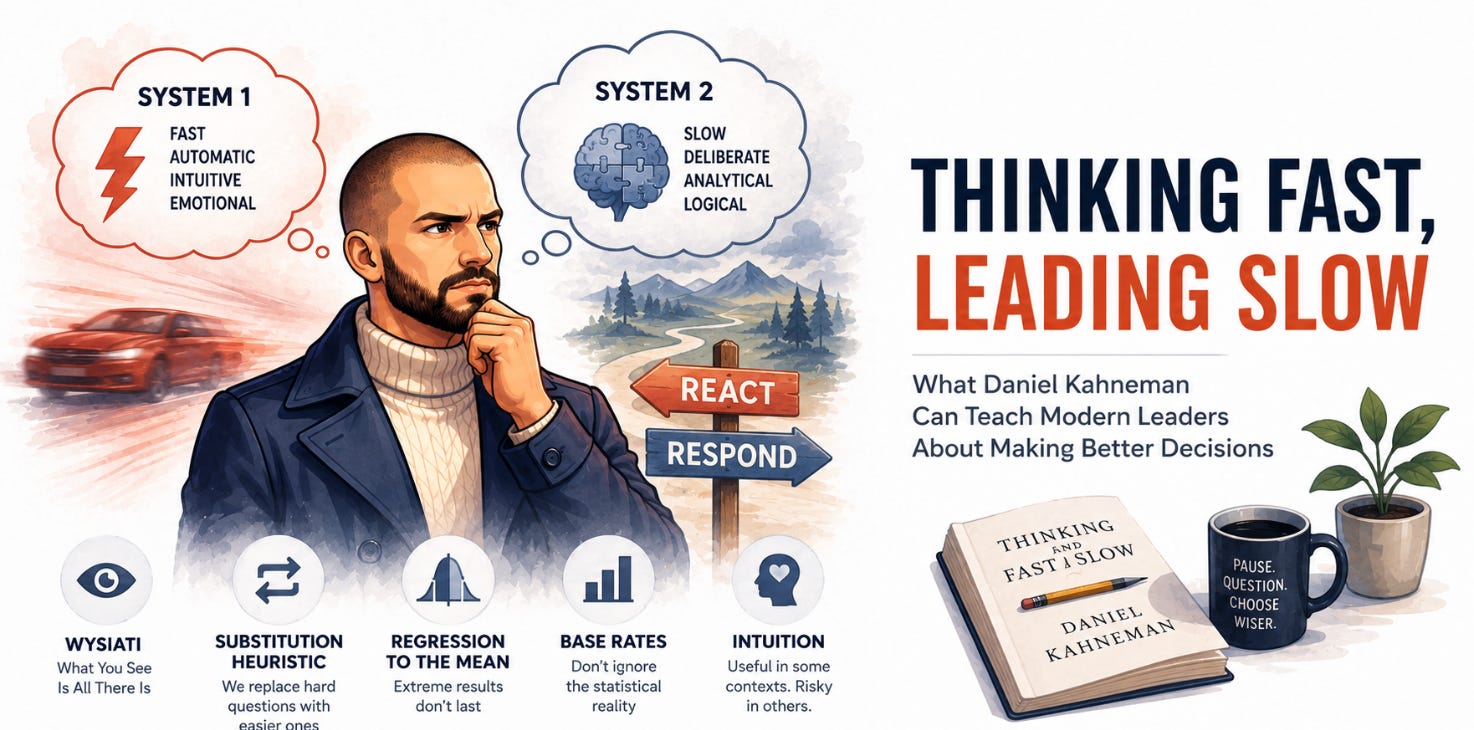
A few months ago, I finally picked up Thinking, Fast and Slow by Daniel Kahneman.
It’s one of those books that gets recommended so often that it almost becomes background noise. You hear people mention it in podcasts, leadership circles, startup communities, and executive coaching conversations. Eventually, I decided it was time to see what all the hype was about.
What surprised me wasn’t the psychology.
It was how much of the book felt like a leadership book.
Because at its core, Thinking, Fast and Slow isn’t really about cognitive science.
It’s about decision-making.
And leadership is, fundamentally, a decision-making profession.
Every day leaders make decisions about people, priorities, promotions, strategy, hiring, delegation, conflict, communication, and risk.
The challenge is that most of us assume we’re making those decisions rationally.
Kahneman’s work suggests otherwise.
His central message is uncomfortable:
Intelligent people are not immune to bad decisions. In many cases, they’re simply better at justifying them.
The good news is that understanding how our minds work gives us a chance to lead more effectively.
Let’s explore a few of the ideas from Thinking, Fast and Slow that I believe every modern leader should understand.
System 1 and System 2: The Two Minds Behind Every Decision
One of the most famous concepts in the book is the distinction between System 1 and System 2 thinking.
System 1 is:
Fast
Automatic
Emotional
Intuitive
Effortless
System 2 is:
Slow
Analytical
Deliberate
Logical
Effortful
Neither system is good or bad.
In fact, we need both.
If you had to consciously analyze every step while walking, driving, or speaking, you would never get anything done.
The problem is that leadership often requires System 2 thinking while our brains default to System 1.
Imagine a senior engineer challenges your proposal during a meeting.
System 1 immediately reacts:
“They’re questioning my authority.”
“They’re being difficult.”
“I need to defend my position.”
System 2 asks different questions:
“What information might they have that I don’t?”
“Could their concern improve the outcome?”
“Am I reacting to the content or to the challenge itself?”
Leadership mistakes don’t happen because leaders lack intelligence.
They happen because leaders don’t notice which system is currently driving their behavior.
The best leaders know when to slow down.
They understood that their first reaction wasn’t always their best one.
WYSIATI: What You See Is All There Is
Kahneman introduces a concept called WYSIATI:
What You See Is All There Is.
It’s one of the most powerful ideas in the entire book.
Our brains are constantly constructing stories from incomplete information.
The problem is that we rarely realize the information is incomplete.
We mistake our interpretation for reality.
This happens constantly in leadership.
An employee misses a deadline.
You conclude they’re disorganized.
A team member is quiet during meetings.
You assume they’re disengaged.
A project falls behind.
You decide someone isn’t performing.
But what if you’re only seeing a tiny fraction of the story?
Maybe the employee is blocked by another team.
Maybe the quiet team member is processing information before speaking.
Maybe the project is suffering from unclear requirements.
Maybe there are organizational constraints nobody has surfaced yet.
The danger isn’t that leaders make assumptions.
The danger is that assumptions quickly start feeling like facts.
Once that happens, we stop investigating.
We stop asking questions.
We stop gathering information.
And we start making decisions based on stories rather than reality.
One of the most valuable leadership habits I’ve developed over the years is asking myself a simple question:
“What information might I be missing?”
It’s amazing how often that question changes the entire situation.
Because leadership is rarely about managing what you know.
It’s about recognizing what you don’t.
The Substitution Heuristic: When Your Brain Answers the Wrong Question
This might be my favorite concept from the book because once you see it, you can’t unsee it.
Kahneman explains that when our brains encounter a difficult question, they often replace it with an easier one without telling us.
The difficult question disappears.
The easier question gets answered.
And we believe we’ve solved the original problem.
Consider a promotion decision.
The difficult question is:
“Is this person ready to lead others?”
That’s a complex question.
It requires evaluating emotional intelligence, communication skills, influence, coaching ability, judgment, and self-awareness.
Instead, our brains often answer:
“Do I like working with this person?”
Or:
“Are they technically strong?”
Or:
“Have they been here a long time?”
Those are much easier questions.
They’re also different questions.
The same thing happens in hiring.
The real question is:
“Will this person perform successfully in this environment over the next several years?”
The substituted question becomes:
“Did they impress me during the interview?”
It happens in strategy too.
The real question is:
“Does this initiative solve a meaningful business problem?”
The substituted question becomes:
“Do I like this idea?”
Many poor leadership decisions are not the result of bad intentions.
They’re the result of answering easier questions than the ones that actually matter.
Great leaders learn to pause and ask:
“What is the real question here?”
That single habit can dramatically improve decision quality.
Regression to the Mean: Why Leaders Often Misinterpret Performance
This concept doesn’t get nearly enough attention.
Regression to the mean sounds complicated, but the principle is simple.
Extreme outcomes are often followed by more average outcomes.
In other words, unusually great performances tend to move closer to normal.
Unusually poor performances tend to move closer to normal too.
Yet leaders constantly misinterpret this phenomenon.
Imagine a high performer has an exceptional quarter.
They exceed every target.
Deliver every project.
Receive praise from stakeholders.
A leader may start assuming this level of performance is the new standard.
Then the next quarter is merely good instead of exceptional.
The leader feels disappointed.
Nothing actually went wrong.
The performance simply moved closer to its typical level.
The opposite happens too.
A team member has a terrible sprint.
The leader delivers strong feedback.
The next sprint improves.
The leader assumes the feedback caused the improvement.
Maybe it did.
Maybe it didn’t.
Maybe the previous sprint was simply an unusually bad outlier.
The lesson isn’t that feedback doesn’t matter.
The lesson is that leaders should be cautious about drawing sweeping conclusions from isolated events.
One great month doesn’t tell you everything.
One bad month doesn’t either.
Strong leaders look for patterns.
Weak leaders react to episodes.
That’s a critical distinction.
Base Rates: The Leadership Skill Nobody Talks About
Humans love stories.
We naturally gravitate toward narratives.
Statistics are less exciting.
Unfortunately, statistics are often more useful.
Kahneman highlights our tendency to ignore base rates.
A base rate is simply the underlying probability of something happening.
Leaders ignore base rates all the time.
A startup founder believes their company will become a unicorn.
A hiring manager believes they’ve found a guaranteed star performer.
A leadership team believes their transformation initiative will succeed.
The question isn’t whether those outcomes are possible.
The question is whether the decision-makers have considered how often similar efforts actually succeed.
Let’s look at hiring.
A candidate gives an incredible interview.
They’re confident.
Articulate.
Charismatic.
The story sounds compelling.
But what’s the base rate?
How many candidates who performed similarly in interviews actually became top performers?
Most leaders never ask.
They trust the narrative.
Base rates force us to balance optimism with reality.
They don’t eliminate ambition.
They simply anchor it.
The next time you’re evaluating a major decision, ask yourself:
“What usually happens in situations like this?”
Not what you hope happens.
Not what happened once.
What usually happens.
That question alone can prevent countless leadership mistakes.
Intuition: When Should Leaders Trust It?
This is another area where Kahneman is often misunderstood.
Many people think his work argues against intuition.
It doesn’t.
It argues against blind trust in intuition.
Kahneman makes an important distinction.
Intuition becomes reliable when two conditions exist:
The environment contains predictable patterns.
The person receives regular, high-quality feedback.
Think about an experienced engineering leader.
After years of leading teams, they may develop strong intuition about:
Team morale
Emerging conflicts
Communication breakdowns
Delivery risks
Stakeholder dynamics
Why?
Because they’ve seen hundreds of examples.
And they’ve received feedback on whether their judgments were correct.
But now consider predicting:
The next major technology shift
Market behavior five years from now
The success of a new organizational structure
The long-term outcome of a strategic bet
These environments provide far less reliable feedback.
Patterns are weaker.
Uncertainty is higher.
Intuition becomes much less trustworthy.
This distinction matters.
Because leaders often become successful in one domain and then assume their intuition is equally reliable everywhere.
That’s a dangerous trap.
Experience creates confidence.
It does not automatically create accuracy.
The best leaders I know trust their intuition enough to form a hypothesis.
Then they seek evidence before turning that hypothesis into a decision.
The Leadership Lesson Behind the Entire Book
After finishing Thinking, Fast and Slow, I don’t think the biggest lesson is that humans are irrational.
The bigger lesson is that we’re predictably irrational.
We make the same mistakes.
We jump to the same conclusions.
We trust the same shortcuts.
We become overly confident.
We ignore probabilities.
We see patterns that aren’t there.
We create stories from incomplete information.
And we do all of this while believing we’re being objective.
Leadership doesn’t magically protect us from these tendencies.
If anything, leadership amplifies them.
The more authority we have, the easier it becomes to mistake our assumptions for reality.
The more experience we gain, the easier it becomes to overestimate the accuracy of our intuition.
The more pressure we face, the more likely we are to rely on mental shortcuts.
That’s why great leadership isn’t about becoming perfectly rational.
That’s impossible.
Great leadership is about becoming aware of how your mind works.
It’s about recognizing when you’re reacting instead of thinking.
When you’re assuming instead of investigating.
When you’re telling yourself a story instead of examining the evidence.
The leaders who consistently make better decisions are rarely the ones with the highest IQ.
They’re the ones who have learned to question their own thinking.
And perhaps that’s Kahneman’s most important lesson for leaders:
The quality of your leadership is often determined by your ability to challenge the conclusions your brain wants you to accept automatically.