

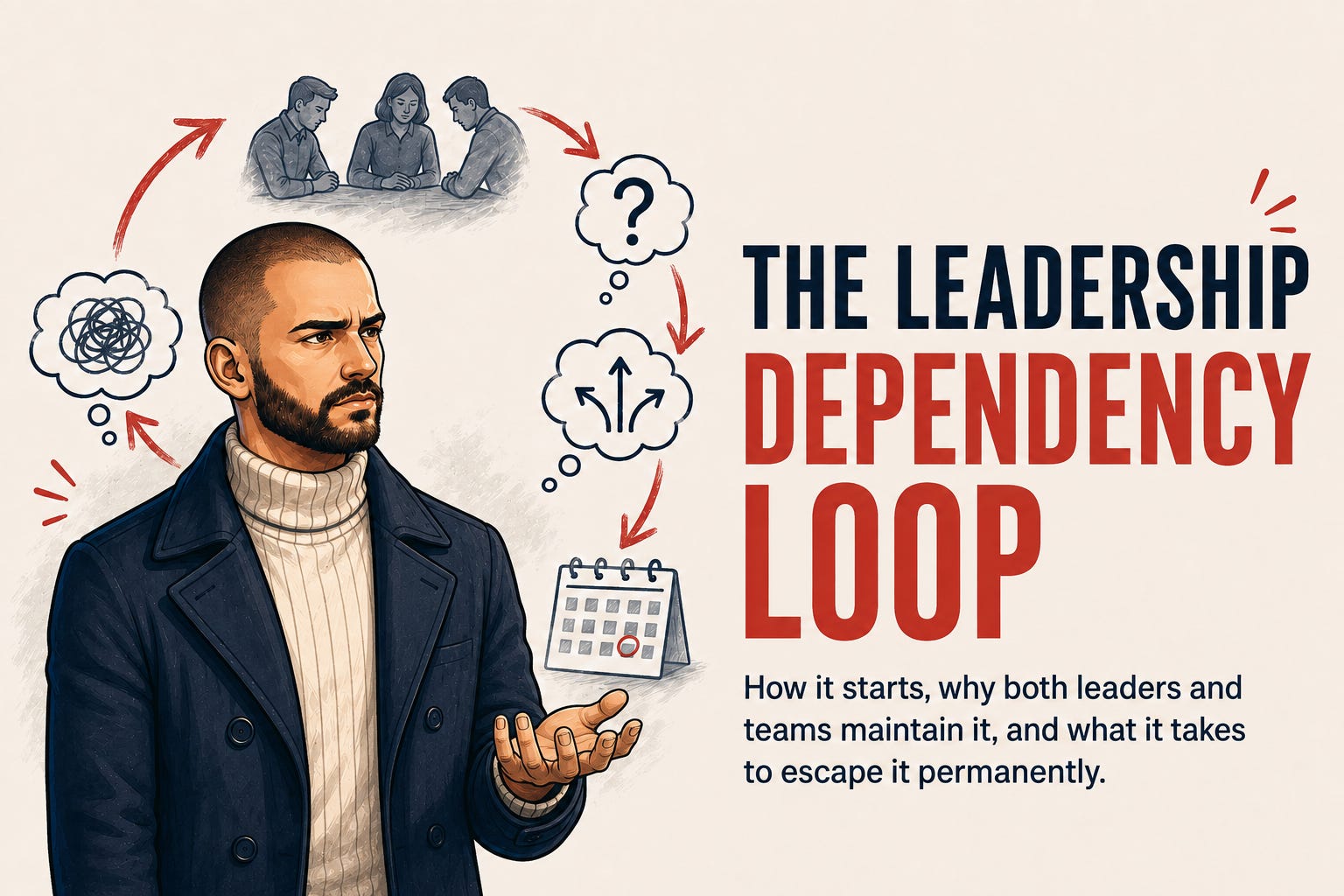
A deadline is getting close and the team is falling behind.
You join a few meetings, make a couple of decisions and help move things forward. The project gets back on track and everyone feels relieved.
The next time something similar happens, people involve you a little earlier. It makes sense. Your involvement worked the first time.
After a while, difficult decisions regularly find their way to you. People ask for your opinion before committing to an idea. You attend meetings just in case the team needs context or someone has to unblock the discussion.
None of this looks particularly problematic.
You are helping the team deliver. You are protecting the quality of the work. You are doing what a responsible leader is expected to do.
The consequences only become visible later.
Your calendar is full. Strategic work keeps getting postponed. People formally own projects, but important decisions still wait for you. When you finally try to step away, progress slows down or the quality drops, confirming your suspicion that the team is not ready yet.
This is how the leadership dependency loop is created.
It rarely comes from one conscious decision to control everything. It develops through hundreds of small interventions that solve an immediate problem while quietly teaching the team to rely on the leader.
The team gets faster answers and less exposure to risk. The leader gets more certainty that the outcome will be protected. Both sides have a reason to maintain the arrangement, even when neither is satisfied with it.
Leaving the loop is therefore more complicated than delegating additional tasks or removing a few meetings from your calendar.
You can reduce your involvement for weeks and still return to the old pattern as soon as a critical deadline approaches, an executive asks a difficult question or an important project starts drifting.
That moment tells you whether the dependency has actually changed.
To understand how to leave the loop, we first need to understand the different ways leaders enter it.
Four Ways Leaders Enter the Loop
Dependency can develop through different leadership habits.
Some leaders enter the loop by solving problems. Others enter it by protecting quality, sharing expertise or carrying too much responsibility.
The result often looks similar, but the reason behind it matters. You cannot change the pattern properly if you do not understand what keeps drawing you into it.
1. The Rescuer
A project is in trouble and the leader steps in.
They reorganize the work, resolve a disagreement or take over a difficult stakeholder conversation. The intervention works, which makes stepping in feel like the responsible choice the next time pressure appears.
Eventually, the team starts escalating problems earlier. There is little reason to struggle with something for hours when the leader can resolve it in twenty minutes.
The leader may complain that people do not take enough ownership, while the team has learned from experience that ownership ends when the situation becomes difficult.
2. The Expert
This pattern is common among leaders who were promoted because they were excellent at the work their team now performs.
They have more context, recognize risks earlier and can often reach a good decision faster than the people around them. Sharing that knowledge seems useful, so they continue contributing to technical discussions, reviewing decisions and suggesting solutions.
The team gradually stops developing its own judgment.
People still do the work, but they look to the leader to confirm that they are heading in the right direction. The leader remains the most knowledgeable person in the room partly because every important question continues to pass through them.
3. The Quality Protector
Some leaders are comfortable delegating tasks, but struggle to accept an outcome they would have approached differently.
They ask more questions, request another revision or add one final improvement before something is considered finished. Their feedback is usually valid. Each individual correction may genuinely improve the result.
The dependency develops when people begin optimizing for the leader’s approval instead of making and defending their own decisions.
Ownership remains limited because the team knows that the final standard is still defined inside the leader’s head.
4. The Responsibility Carrier
This leader believes they will ultimately be held accountable for everything the team does.
When a deadline is missed, they feel they should have noticed the risk earlier. When someone makes a poor decision, they question whether they provided enough guidance. When senior leadership asks for reassurance, they personally verify the details before answering.
They may delegate the work, but they continue carrying the mental responsibility for every possible outcome.
That responsibility keeps pulling them back into updates, reviews and meetings. Being informed never feels sufficient. To feel confident, they need to be involved.
These patterns often overlap.
An expert can become a rescuer when a deadline approaches. A quality protector can carry too much responsibility because they expect to answer for every mistake. The exact combination matters less than recognizing the exchange that keeps the loop in place.
Every intervention gives the team something useful in the moment. It also gives the leader something, which is where the psychological side of dependency begins.
Why Being Needed Is Difficult to Give Up
It is easy to see what the team receives from the dependency loop.
They get quick answers, protection from mistakes and access to someone with more experience. Difficult decisions feel safer when a senior leader confirms them. Under pressure, involving the leader can also reduce the personal risk of being wrong.
The leader receives something too.
Solving a problem creates an immediate sense of progress. Joining a struggling project restores a feeling of control. Being asked for advice confirms that your experience is valuable and that your role matters.
Psychologists Edward Deci and Richard Ryan describe competence as one of three basic psychological needs, alongside autonomy and relatedness. In their Self Determination Theory, competence refers to our need to feel effective and capable of producing meaningful results.
This offers a useful lens for understanding the dependency loop.
Strategic leadership often provides weak and delayed evidence of competence. You can spend weeks improving an operating model, developing someone’s judgment or aligning stakeholders without seeing a clear result.
Solving a concrete problem provides that evidence immediately.
The decision gets made. The incident gets resolved. The team moves forward. You can clearly see the connection between your involvement and the result.
There is also a second psychological mechanism at work.
In behavioural psychology, negative reinforcement occurs when removing an unpleasant experience makes a behaviour more likely to be repeated. It is frequently confused with punishment, but it describes something much simpler: a behaviour becomes stronger because it provides relief.
A project starts drifting and the leader experiences uncertainty. They step in, make a decision and the uncertainty decreases.
The next time pressure appears, stepping in becomes even more attractive.
The team goes through a similar learning process. Escalating the problem removes the discomfort of making a difficult decision alone. Each successful escalation makes the next one more likely.
Both sides are rewarded by immediate relief, even though the long term dependency becomes stronger.
There is also an identity problem.
Many engineering leaders built their careers by being dependable. They understood the system, stayed calm during incidents and found solutions when others were stuck. Their ability to step in earned them trust and eventually helped them move into leadership.
The same behaviour becomes less useful as their scope grows.
Stepping away can feel like a loss of value. You attend fewer discussions, make fewer visible decisions and no longer have detailed answers to every question. Meanwhile, other people begin doing the work that previously demonstrated your importance.
Even when this is exactly what the organization needs, it can feel as if you are contributing less.
This is why advice to delegate more often changes very little.
Delegation describes the visible action. It does not address the need for competence, the relief created by regaining control or the discomfort that appears after the work has been delegated.
The real test begins when the team chooses a different approach, progress becomes harder to observe or the first mistake happens.
At that point, the leader has to choose between removing the immediate uncertainty and allowing the team to develop the judgment required to operate independently.
Repeated often enough, choosing immediate relief creates a team that escalates and a leader who cannot step away.
The Cost of Holding Everything Together
The first cost of the dependency loop is usually visible in the leader’s calendar.
There are too many meetings, too many decisions and too many conversations that cannot move forward without them. Strategic work is postponed until things become quieter, although things rarely become quieter for a person who sits inside every important workflow.
The larger cost is harder to see.
When leaders repeatedly provide answers, teams lose opportunities to develop judgment.
Judgment is not built by watching an experienced person make good decisions. It develops through making decisions, defending the reasoning behind them and experiencing the consequences.
A team protected from poor decisions is also protected from the learning required to make better ones.
This creates a misleading cycle.
The leader steps back and the quality temporarily drops. They interpret the drop as proof that their involvement is still necessary, so they return. The team gets fewer opportunities to practise independent decision making, which makes the next attempt to step back equally difficult.
The gap in capability remains, partly because every attempt to expose it is quickly interrupted.
Ownership also becomes unclear.
Someone may own a project on paper, but ownership means little if the important decisions still require approval. People learn how far they can move independently and where the invisible boundary begins.
Before long, they stop approaching that boundary altogether.
They bring recommendations instead of decisions. They wait for feedback before committing. They learn to predict what the leader wants rather than developing and expressing their own point of view.
This can create the appearance of alignment while hiding a lack of real ownership.
The loop also changes how the organization sees the leader.
Being present in every critical situation can make someone look indispensable. They know what is happening, people rely on them and important work moves faster when they are involved.
Indispensability feels like evidence of value, but it can also reveal that leadership has not scaled.
As the team grows, the leader’s capacity stays roughly the same. More people create more questions, more decisions and more coordination. If all of that continues to flow through one person, growth makes the system slower instead of stronger.
Eventually, the leader reaches a ceiling.
They cannot take on a broader role because the current one still requires their constant presence. They cannot focus on longer term problems because immediate issues always appear more urgent. They cannot fully develop future leaders because those people never receive enough real authority.
The team becomes dependent on the leader.
The leader becomes dependent on being involved.
The organization becomes dependent on a system that cannot scale.
Is It Okay to Want to Work Less?
Some leaders feel uncomfortable admitting that they want fewer meetings, fewer operational decisions and fewer problems following them home.
Wanting that can sound selfish.
Leadership is associated with responsibility. As your role grows, it seems reasonable to expect more pressure, more difficult decisions and more demands on your time.
This can lead to a quiet assumption that exhaustion is evidence of commitment.
If your calendar is full and everyone needs you, you must be carrying an important role. If the team can operate without you, perhaps you are no longer adding enough value.
That assumption deserves to be challenged.
A leader whose team can operate independently has not escaped responsibility. They have distributed it successfully.
Reducing your involvement can be a legitimate leadership goal. The way you achieve it determines whether it represents progress.
You can work less by avoiding difficult conversations, lowering standards or transferring your workload to already overloaded people. That creates distance without creating capability.
You can also work less by building clearer ownership, improving how decisions are made and helping people develop enough judgment to solve problems without waiting for you.
The second version makes the organization stronger.
The goal is not an empty calendar.
A senior leader should still be involved where their perspective, authority or context creates meaningful value. They should help define direction, navigate ambiguity, develop people and address problems that cannot be resolved at a lower level.
Their time should reflect the scope of their role.
When a leader spends most of the week answering questions that someone else could learn to answer, their calendar is revealing a design problem.
The same applies to meetings.
Fewer meetings are useful only when decisions continue to be made, information still travels and people know how to coordinate without the leader acting as the connection between them.
Removing meetings before changing those conditions simply moves the confusion elsewhere.
This is why working less cannot be separated from building capability.
If your absence causes everything to slow down, the system is still dependent on you. If work continues, decisions get made and standards remain clear, your reduced involvement is evidence that your leadership has scaled.
The ambition to work less is therefore entirely reasonable.
A better question is whether your way of working less leaves the team more capable than before.
Getting Out of the Loop
Leaving the loop requires more than deciding to become less involved.
If you simply stop attending meetings and answering questions, the dependency remains. The team loses access to the person around whom the system was built, but it does not automatically gain the context, authority or judgment needed to operate independently.
The work begins by identifying where dependency actually exists.
Look for decisions that repeatedly return to you, meetings that struggle to progress without you and problems people escalate before exploring them fully.
Your calendar can be useful evidence.
For each recurring meeting, ask what would happen if you stopped attending. If decisions would no longer be made, identify what people currently receive from your presence. It may be authority, context, conflict resolution or confidence that someone will take responsibility for the outcome.
Once you understand that function, you can transfer it deliberately.
Transfer decisions, not only tasks
Delegating work while retaining decision authority creates limited ownership.
Someone can manage an entire project and still depend on you if they need approval for every meaningful tradeoff. The project belongs to them operationally, but the judgment still belongs to you.
Clarify which decisions they can make, which outcomes they are responsible for and which conditions require escalation.
The goal is not to eliminate escalation. It is to make escalation a deliberate response to defined risk rather than a habit created by uncertainty.
Replace answers with thinking
When someone brings you a problem, providing the answer is often the fastest option.
It also keeps the thinking with you.
Ask what they have already considered, which option they recommend and what tradeoffs shaped their recommendation. If their reasoning is sound, let the decision remain theirs.
This will feel slower at first.
That additional time is part of building capability. Without it, the same category of problem will continue returning to you.
Make standards visible
Quality dependency often develops when the team has to predict what the leader will accept.
If expectations live only inside your head, people have little choice but to involve you. They need your reaction to discover whether their decision meets the standard.
Turn repeated feedback into explicit principles, constraints and examples. Let people challenge those standards and apply them without requiring your approval each time.
The objective is shared judgment, not accurate imitation of the leader.
Allow different decisions
Independent teams will make choices you would not make.
Intervening whenever their approach differs from yours teaches them that autonomy exists only while they reach the same conclusion.
Evaluate the quality of the reasoning, the size of the risk and whether the decision can be reversed. A different approach does not automatically require correction.
Some decisions will produce weaker results. Those moments create the information needed to improve judgment, as long as the cost of learning is understood and contained.
Change your own measure of progress
If your sense of productivity still comes from solving visible problems, stepping away will continue to feel unsatisfying.
Start noticing a different set of outcomes.
Which decisions were made without you?
Who handled a difficult conversation independently?
Where did the team maintain quality without your review?
Which recurring problem stopped returning to your calendar?
These are less visible than resolving an incident or rescuing a delivery. They are stronger evidence that your leadership is scaling.
Getting out of the loop happens gradually.
You transfer context, decision authority and opportunities to learn. You remain available while resisting the habit of taking the work back.
Then pressure rises, and the entire arrangement is tested.
Why Leaders Return When Pressure Rises
A team can appear independent while conditions are stable.
Deadlines are realistic, progress is visible and mistakes are affordable. The leader has enough time to ask questions, tolerate a slower decision and allow people to work through uncertainty.
Pressure changes that calculation.
A critical deadline approaches. An important client complains. Senior leadership asks for reassurance. The cost of a poor decision suddenly feels much higher.
The leader becomes more involved.
They ask for additional updates, join working sessions and review decisions that the team previously made independently. It is usually presented as temporary support until the situation stabilizes.
The team understands the message differently.
They learn that their authority applies when risk is low. Once the outcome becomes important enough, control returns to the leader.
This is how a few weeks of pressure can rebuild a dependency that took months to reduce.
The leader also receives immediate confirmation that returning was necessary. Communication becomes faster. Decisions feel more controlled. Problems may get resolved sooner.
What remains invisible is the capability that the team could have developed by handling the situation itself.
Staying out of the loop does not mean watching passively while a project fails.
It means resisting the automatic assumption that greater risk always requires greater control.
Sometimes direct intervention is necessary. A team may lack critical information, a decision may be irreversible or the potential damage may exceed a reasonable learning cost.
The difference lies in whether intervention is a considered response to the risk or the leader’s default response to discomfort.
Before stepping back in, ask:
What specific risk requires my involvement?
Does the team lack authority, context or capability?
Can I provide what is missing without taking ownership back?
Is this decision difficult to reverse?
What will the team learn about ownership from the way I respond?
These questions create enough distance to choose your role deliberately.
You may still decide to become involved. If you do, make the boundary explicit.
Explain why the situation requires a temporary change, which decisions remain with the team and when the previous ownership model will resume. Once the pressure passes, return authority deliberately rather than allowing temporary involvement to become the new operating model.
The aim is not to prove that the team never needs you.
It is to build a team that can use your support without transferring the entire problem back to you.
Pressure reveals whether ownership has genuinely moved.
If the leader takes control every time the stakes rise, the team has received responsibility without real authority. If the team continues making decisions while the leader provides context, removes external obstacles and helps contain risk, the system has started to change.
Getting out of the loop during calm periods creates space.
Staying out when the outcome matters creates independence.
What Changes When You Stay Out
The first sign of progress is not an empty calendar.
It is what happens without you.
Decisions continue to be made. People disagree and resolve the disagreement. Problems reach you with clearer thinking and a specific request for support. A difficult week does not automatically pull every important decision upward.
Your role changes too.
You spend less time providing answers and more time improving the conditions in which good answers are found. You work on direction, decision quality, leadership capability and the obstacles that people within the team cannot remove themselves.
You may know less about the daily details.
At first, that can feel uncomfortable. Detailed knowledge previously gave you confidence that the work was under control. Over time, confidence begins to come from somewhere else: clear ownership, capable people and a system that exposes meaningful risk without requiring your presence everywhere.
The team will still need you.
They will need context, coaching, protection from organizational noise and support when the situation exceeds their current authority or experience. The relationship becomes healthier when needing support no longer means giving ownership back.
This is the real shift behind getting out of the loop.
The leader stops being the place where work, decisions and responsibility accumulate. Their value moves into the system they create around the work.
That shift takes more than delegation.
It requires examining what repeatedly pulls you in, what your involvement provides to the team and what being needed provides to you. It also requires staying with the discomfort long enough for a different pattern to develop.
If your team still relies on you for too many decisions, problems and meetings, this is exactly what I work on with founders and engineering leaders.
Over 10 to 12 weeks, we identify where dependency has formed, redesign ownership and help you step back without losing visibility, quality or control of outcomes.
Reply with LOOP if you want to explore whether the program fits your situation.