

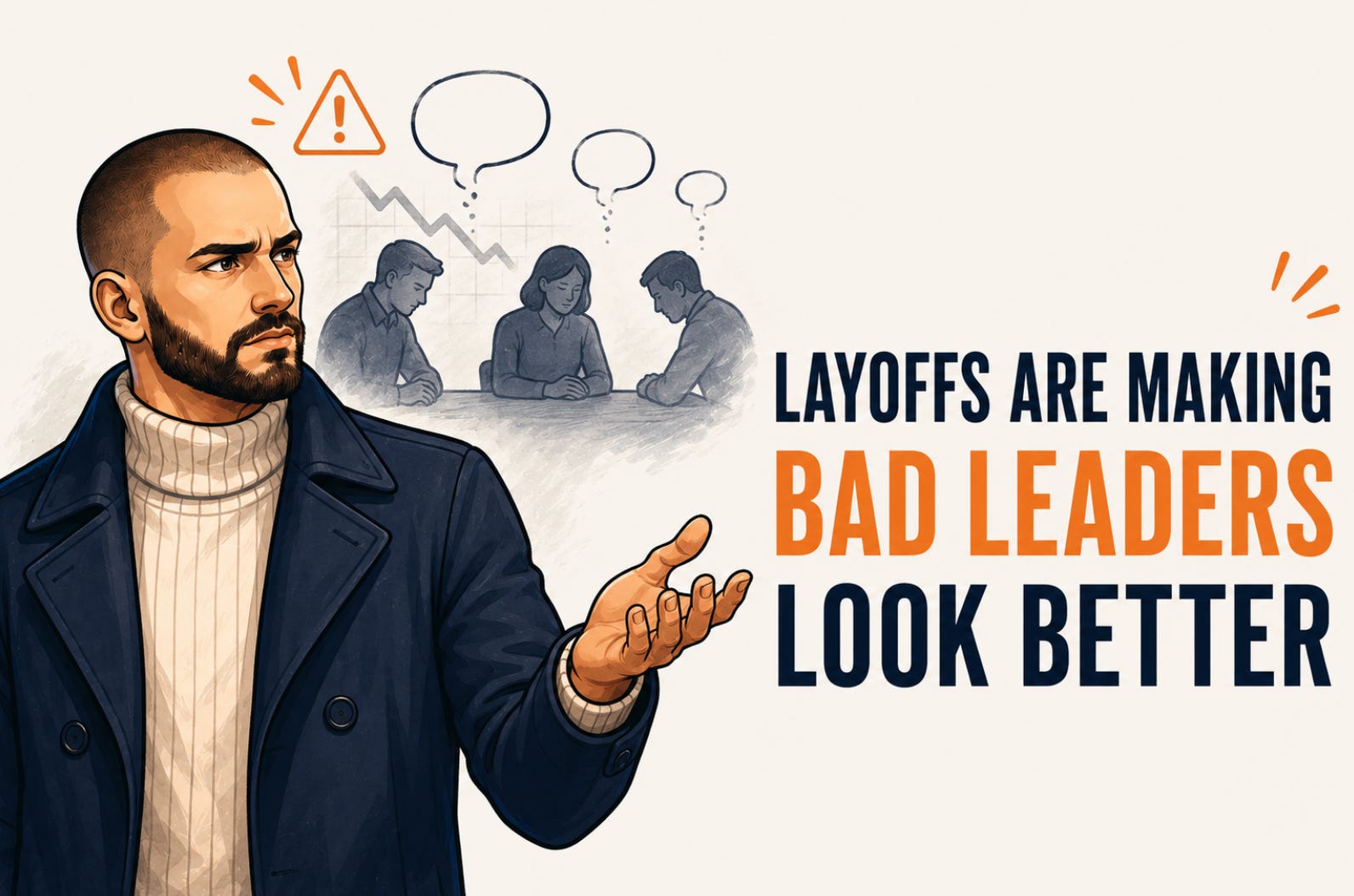
Last week, I shared a LinkedIn post about something I’ve been noticing inside engineering teams.
A few years ago, engineers had options everywhere.
If they didn’t feel respected, they left.
If they didn’t feel heard, they left.
If a manager consistently created a bad environment, the market made that failure visible very quickly.
The post reached more than 180,000 impressions.
But what caught my attention wasn’t the number.
It was how many engineers and engineering leaders recognized the same shift.
People are staying quieter.
They are challenging fewer decisions.
They are accepting things they would have pushed back on a few years ago.
From the outside, this can look like alignment.
The team seems calmer.
Decisions move faster.
There is less conflict.
People appear more committed.
And if you’re the leader of that team, it can be tempting to believe that you’ve become better at your job.
But there is another possible explanation.
Maybe your team didn’t become more aligned.
Maybe disagreeing with you simply became more expensive.
That distinction matters.
Because layoffs didn’t only change the job market.
They changed the balance of power inside engineering teams.
And in doing so, they created an environment where bad leadership can look surprisingly effective.
When the market forced leaders to be better
The hiring market of a few years ago had plenty of problems.
Engineers sometimes left too quickly.
Companies competed with increasingly unrealistic salaries and benefits.
Managers spent enormous amounts of energy on retention.
And sometimes people confused psychological safety with never feeling uncomfortable.
I don’t want to romanticize that period.
But it did create one useful pressure.
Leaders couldn’t rely only on authority.
If people didn’t trust you, they had options.
If you ignored them long enough, they left.
If you treated experienced engineers like interchangeable resources, another company was waiting to hire them.
That forced many engineering leaders to become better.
We had to think seriously about autonomy.
Career growth.
Psychological safety.
Healthy disagreement.
The quality of 1:1s.
The way decisions were explained.
The way feedback was delivered.
Not always because every company suddenly became deeply human.
Sometimes simply because losing good engineers was expensive.
But regardless of the motivation, leaders had to earn more of their influence.
Then the market changed.
When leaving stopped feeling easy
After repeated rounds of layoffs, hiring freezes, and long job searches, changing jobs started carrying more risk.
People saw strong engineers lose their jobs.
They saw respected leaders disappear during reorganizations.
They saw colleagues spend months searching for their next role.
And naturally, people adapted.
They became more careful.
Not only about leaving.
About speaking.
A disagreement that once felt like a normal part of engineering discussion can now feel like unnecessary exposure.
Pushing back on an unrealistic deadline can feel risky.
Questioning a senior leader’s decision can feel less like intellectual honesty and more like making yourself visible for the wrong reason.
Even when nobody explicitly says:
“Don’t challenge this.”
The environment can still teach people to stay quiet.
That is how power works inside organizations.
It doesn’t always need to be announced.
People notice what is rewarded.
They notice what creates tension.
They notice who gets described as “difficult.”
And when the external market feels unsafe, they become much less willing to test the boundaries of the internal one.
When fear starts looking like alignment
This is where things become dangerous for leaders.
Because fear rarely arrives in a meeting and introduces itself.
It looks professional.
People nod.
They say:
“I guess that’s fine.”
They stop reopening decisions.
They stop raising the same concern after it has already been dismissed once.
They accept the deadline.
They take the work away and try to make it happen.
From a manager’s perspective, this can feel like progress.
Less resistance.
Fewer debates.
Faster meetings.
More execution.
And slowly, a dangerous story starts forming:
“The team finally trusts my judgment.”
“They’ve become more mature.”
“We used to overanalyze everything. Now we just move.”
Maybe.
But perhaps people have simply learned that disagreement is no longer worth the emotional or professional cost.
Silence and trust can look almost identical from the leader’s chair.
That is why positional authority is so psychologically deceptive.
The higher you go, the easier it becomes to mistake the absence of resistance for the presence of support.
Compliance is easier to lead than trust
There is a reason authoritarian leadership can feel effective in the short term.
Compliance is fast.
You make a decision.
People follow it.
There is less negotiation and less visible conflict.
Trust is slower.
People question assumptions.
They introduce information you didn’t have.
They make decisions messier before they make them better.
They sometimes tell you that your idea won’t work.
That can feel inefficient.
Especially under pressure.
But engineering work depends on information flowing upward.
The engineer closest to the system often sees a risk before the manager does.
The person implementing the decision understands constraints that were invisible in the leadership meeting.
The quiet doubt someone carries today can become the production incident everyone discusses next month.
When people stop challenging decisions, leaders don’t suddenly become right more often.
They simply receive less evidence that they might be wrong.
And that creates a dangerous feedback loop.
The team challenges less.
The leader experiences less resistance.
Less resistance feels like stronger leadership.
The leader becomes more confident and more directive.
The team becomes even quieter.
Eventually the leader is operating with less real information while feeling more certain than ever.
That isn’t alignment.
It is organizational blindness.
Not every disagreement is psychological safety
There is another side to this conversation that I think matters.
Psychological safety does not mean every decision needs endless debate.
It doesn’t mean leaders should avoid being directive.
And it doesn’t mean every employee who disagrees should get their way.
Some situations require a clear decision.
Some teams need more structure.
Some conversations have already happened, and execution needs to begin.
I have led teams where too much discussion became its own form of avoidance.
People kept asking for more clarity when the real problem was discomfort with committing.
Good leadership sometimes means saying:
“I’ve heard the concerns. This is the decision, and we are moving forward.”
But there is a huge difference between ending a discussion after people have spoken honestly...
...and creating an environment where they decide not to speak at all.
The goal is not permanent consensus.
The goal is access to the truth before the decision is made.
The test leaders need now
So how do you know whether your team is aligned or simply careful around you?
I don’t think another anonymous engagement survey will answer that.
Watch what happens in real conversations.
When was the last time someone changed your mind in a meeting?
When was the last time an engineer openly said your deadline was unrealistic?
Do concerns appear early, when they can still help, or late, when the decision is already failing?
Do people disagree with you in a group, or only privately after the meeting?
When someone challenges you, do you become curious... or immediately start explaining why they’re wrong?
And perhaps the hardest question:
What would my team say if disagreeing with me carried absolutely no cost?
You may never know the complete answer.
The power difference between a manager and an employee can’t be removed entirely.
But your behavior teaches people how safe that difference is.
Every time someone challenges you, the room watches what happens next.
Do you explore the concern?
Do you ask questions?
Do you acknowledge when they see something you missed?
Or do you become colder, more defensive, and slightly less inclusive afterward?
Culture is built in those small moments.
Not in the value written on the company website.
Culture has a long memory
The current market will not last forever.
At some point, opportunities will increase again.
Changing jobs will feel less dangerous.
Engineers will have more leverage.
And when that happens, companies may suddenly discover that the calm they were seeing was never loyalty.
It was waiting.
People may not remember every roadmap decision.
But they will remember what leadership felt like when they had fewer options.
They will remember who continued investing in trust.
Who invited disagreement.
Who protected people under pressure.
And who saw a difficult market as permission to stop trying.
That is why I believe this period is such an important leadership test.
It is relatively easy to care about psychological safety when retention depends on it.
It is much harder to keep creating it when people are less likely to leave.
But that is exactly when it reveals what your culture was built on.
Trust...
or market conditions.
Final thought
The real test of leadership is not how people behave when they can easily leave.
It is how you lead when they feel they can’t.
Because authority becomes easiest to abuse precisely when nobody feels safe enough to resist it.
And one day, the market will change again.
But culture has a very long memory.
P.S. This essay expands on the LinkedIn post that reached more than 180,000 impressions.